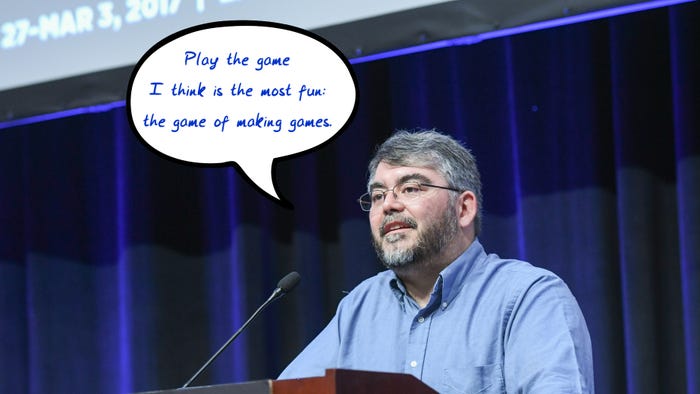
PC game designer Doug Church, whose credits include titles in the Ultima, Thief and System Shock series, has taken a position with Seattle area Half-Life and Portal creator Valve, the company confirmed to Gamasutra today.
Church has worked in the industry since the early '90s, when he contributed to projects from Origin Systems and Looking Glass Technologies. He held a position with Eidos until May 2005, when he left to become an executive producer at EA Los Angeles.
At Electronic Arts, he was associated with a long in-development game codenamed Project LMNO in association with noted film director Steven Spielberg, although that title was eventually canceled.
In a 2004 Gamasutra interview, Church discussed how he felt using distinct genres to describe games did a disservice to tiles that mixed different ideas.
"Sometimes I think that genre is our shorthand to talk about play, and that's about as specific as we'd get, because when I show you imagery of a lot of games and the communication message," he said.
"You know 'you're a powerful wizard', or 'you're going to defeat terrorists' or 'you're going to pilot planes', it doesn't really tell you anything about what you're going to actually do? Like: What are the verbs you have? What are the buttons you're going to use? What sort of mental action do you get? Why are you even there? Why isn't it just a movie?" he continued.
[UPDATE: Valve's Doug Lombardi tells Gamasutra that Church has been with the company for "a couple [of] weeks," though he was unsure what, if any, specific project the designer has been assigned to.]
I actually hope that's not the case. Church is known for games with a high level of player agency, and Half-Life exists pretty far away on that particular gameplay spectrum. It's hard for me to imagine Church making a Half-Life game without fundamentally altering the approach of the game or of his style.
This. Without genre, there would be a pretty serious barrier that would prevent anyone from proposing games (and/or game ideas) to others in hopes that they will find them interesting, too. Outside of this proposal, however, they should be viewed subjectively on a case-by-case basis (much like music or film).
Genre is just an easy way to define a mode of production. It's kind of like putting things in the wrong order; with the most important aspect -- the user experience at the arse end of things. At best a guide or conjunction, at worst reducing old bones to a slurry.
In architecture you might call things a house, or a bridge or a tunnel but it is no indication of use. People often live under bridges, and jump off rooftops to their death. All depends on intent.
Yeah. It's very easy to disregard ideas because that idea is hard to simply explain to someone, given the shared knowledge of existing game genres.
I think what he's saying is a very personal statement of creative intent. Don't be a slave to genre boundaries. Perhaps use them to give context to new ideas, but be aware that referencing genre may carry more weight than you intend, causing people to discount these ideas as absurd.
This is why I have moved more and more over to iterative prototyping, rather than documentation. Proof of concepts are far tighter at explaining new concepts than high level docs - they don't suffer so much from (at either end of the spectrum) ambiguity or information overload.
The most entertaining theory I've heard so far combines Doug Church's emergent gameplay design experience with the light procedural generation of world-content in L4D with the offer to hire Notch of Minecraft fame.
I'm not sure what that adds up to, other than a probable new franchise property (i.e., not HL2:Ep3 or HL3), but it's fascinating to think about. :)
The same is true for every medium!
In architecture you might call things a house, or a bridge or a tunnel but it is no indication of use. People often live under bridges, and jump off rooftops to their death. All depends on intent.
-- Chuan
I think what he's saying is a very personal statement of creative intent. Don't be a slave to genre boundaries. Perhaps use them to give context to new ideas, but be aware that referencing genre may carry more weight than you intend, causing people to discount these ideas as absurd.
This is why I have moved more and more over to iterative prototyping, rather than documentation. Proof of concepts are far tighter at explaining new concepts than high level docs - they don't suffer so much from (at either end of the spectrum) ambiguity or information overload.
I'm not sure what that adds up to, other than a probable new franchise property (i.e., not HL2:Ep3 or HL3), but it's fascinating to think about. :)