My Message close
GAME JOBS
Latest Blogs
spacer View All     Post     RSS spacer
 
May 19, 2013
 
All You Need is Love [3]
 
Students: Tips for Learning Game Development Over the Summer [1]
 
All Your Nintendo Let's Plays Are Belong To Nintendo? [77]
 
Even Further Down the Curation Rabbithole [11]
 
Systems of Control in F2P [25]
spacer
Latest Jobs
spacer View All     Post a Job     RSS spacer
 
May 19, 2013
 
Sony Computer Entertainment America LLC
Sr. Network Systems Engineer
 
Treyarch / Activision
Technical Animator
 
Amazon Game Studios
Sr. Game Designer
 
Amazon Game Studios
Quality Assurance Manager
 
Amazon Game Studios
Game Graphics Engineer
 
Amazon Game Studios
Game Development Engineer
spacer
Latest Press Releases
spacer View All     RSS spacer
 
May 19, 2013
 
Zeeek and The Secret of
Space Octopuses heading
to...
 
Battle bad 'bots in Bad
Bots, available now on...
 
Temple Run 2 Adds New
Terrain and Obstacles
in...
 
Little Amazon runs
through Android
 
Command Ops gets a
Massive Update!
spacer
About
spacer Editor-In-Chief:
Kris Graft
Blog Director:
Christian Nutt
Senior Contributing Editor:
Brandon Sheffield
News Editors:
Mike Rose, Kris Ligman
Editors-At-Large:
Leigh Alexander, Chris Morris
Advertising:
Jennifer Sulik
Recruitment:
Gina Gross
Education:
Gillian Crowley
 
Contact Gamasutra
 
Report a Problem
 
Submit News
 
Comment Guidelines
Sponsor

 
GDC China: Brian Fargo Shares RPG Storytelling Techniques
 

November 13, 2011   |   By Brandon Sheffield

Comments 1 comments

More: Console/PC, China, Design


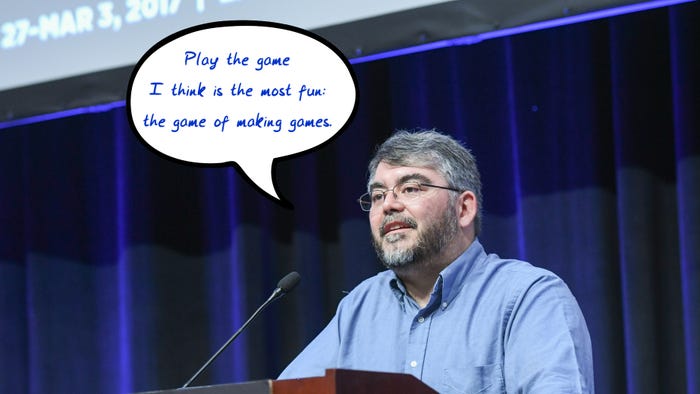
Brian Fargo's games, especially Fallout, have been lauded for their story interactivity and emergent systems. During his keynote at GDC China in Shanghai this week, he revealed his techniques for developing an interesting story in a role playing game.

First, of course, you have to make interesting characters, that have human flaws and backgrounds. "Once you buy into those characters, you could put them in any environment," he says. Many games just go with the simple trope of an evil villain and a reluctant hero. "Maybe there are some other human attributes you can assign to these characters," he says.

"Once you know who these characters are, the writing comes very easily." You need to know who these characters are and how they would react to things, he says.

"It's okay if when the game starts, your character has a history that the players don't know about. Lots of games start with people talking about 1,000 years ago, but we don't know anything about the character's background."

Next, Fargo cautions that the bad guys need to do something evil. In many games, you don't see the true face of the enemy until the end of the game.

Imagine, he posed, if Star Wars were created with Darth Vader just showing up at the end, saying he was Luke's father. In this case, Luke would look like the villain. "Let [the villain] do something to make it personal," he says. "Make him knock you back three levels."

In game storytelling, the journey is the reward, not the plot points. In Pulp Fiction, for example, the plot surrounds a briefcase you never even get to see inside. The actual enjoyment people get from the story is through the minor character interactions along the way.

"Something we put in Wasteland, we put a place the players cannot get to," he said. "They'll try, but they'll get killed. When they finally beat that area and get into it, it's a great feeling. You finally beat the guys who had been killing you along the way. That little moment in the journey was more important than the goals. That's more important than the overall plotline."

RPG storytelling also needs to stay true to itself, and be logical, even if it's fantastic. "We do all these crazy things, but there's a logical world that get behind it," he says. "It's the little moments that have to work." If things seem illogical, you'll lose people. Like in Waterworld, everyone is trying to get this girl with a tattoo on her back - but why didn't they just write it down and be done with it?

Anticipation is a great tool in RPG storytelling, he says, which isn't used often enough. "Here's a picture of a guy walking down the street," he said. "You don't have any emotional reaction. But if I show you this scene first, where here's a building with a safe flying out of a window, and then you see the guy walking. It changes the context with which you're viewing the guy." Roleplaying storytelling doesn't do enough of this, he says.

Also, you should let the systems create the best moments in game storytelling. "If I say here's a sword and you worked two hours to get a sword and you're told there's an ogre in a cave who wants it, and you go there and you steal it, you're mad!" he says. To Fargo, the threat of time loss is a big motivator.

Another example is scarce ammo. If there's a helper NPC that is great with a machine gun, you'll give her that weapon, but she's trigger happy. When she empties a full clip of rare ammo into a rat, you'll be screaming and emotional, he says, but that's not a moment that was scripted by the designer, it's just part of the system.

Your story should have some personality, too, not be a faceless stoic text. "We allow people to kill chickens in all our games," he says. "That's a little secret. I don't know why." After people kill 50 chickens in Bard's Tale, a huge chicken comes out and beats you down.

Lastly, you should inject psychological manipulation and shock. Let the player think one thing, then take them somewhere else. Or let the protagonist die, or even worse, let their dog die. "You can kill human NPCs all day long and nobody will care. But kill their dog, and they're up in arms."
 
 
Top Stories

image
The laws behind Nintendo's Let's Play crackdown
image
New layoffs reach Trion
image
How developers mess up immersion (you might be doing it wrong)
image
Steam Trading Cards: The next-gen of achievements?


Comments

Frank Gilson
profile image
"When she empties a full clip of rare ammo into a rat, you'll be screaming and emotional"


I'll be screaming at the game design...and want to reload prior to the waste of that precious resource. There's a fine line between creating good emotional moments and abusing the player. Be careful.


none
 
Comment:


UBM Tech