|
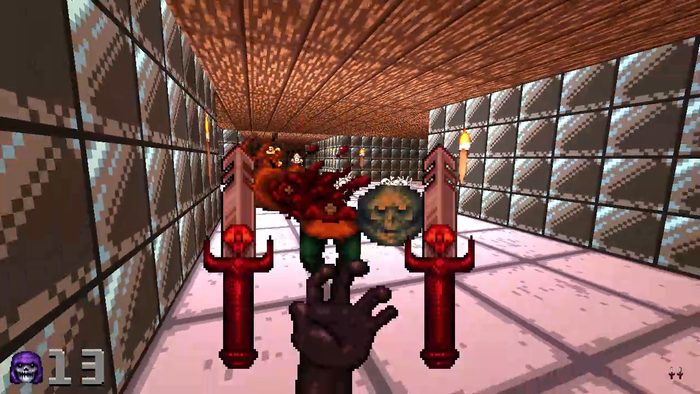
As a game designer I think it's always good to go back and replay games that we remember fondly or that influenced us in some powerful way. Sometimes you find that it's aged poorly but still has some potency. Sometimes you find that you really had bad taste when you were younger. And every once in a while you find that it is far more compelling than you remember, and have this wonderful experience that you never expected, like a few weeks ago when I played Doom for the first time in a decade.
There are a few different reasons I wanted to go back and play Doom. First, this game had a pretty big influence on me. Not in that I got into satanism or marksmanship, but that Doom and its grandpappy Wolfenstein were my introduction to level design and game modifications. Many a geeky hour was spent sketching and building out entire campaigns with kickin' custom MIDI soundtracks (which, during any given week, would include tracks from the Peter Gunn TV show and the Spice Girls). I figured out ways to to lay out levels so that they felt like they were overlapping, even though they weren't.
Second, I played this game a lot. I was too young to be in on the college LAN scene when Doom dropped, so it was all single-player play. But the lighting, level design, art, and especially sound effects are all still pretty deeply ingrained in my psyche. I was really curious to see how the game stood up against the likes of Killzone 2, or Halo 3, or even Half-Life 2. I wanted to see if it just felt clumsy and stupid next to its shiny new great-great-grandkids.
Not exactly next-gen, is it!
Playing through the entire first episode of Doom in one sitting that morning was the most fun I've had playing any game in months, if not years. It didn't feel clumsy at all; Doom is a very fast game, unrealistically reactive to your input, and it is still a joy to sprint through the martian facilities. But the thing that I noticed almost immediately is how completely fun the experience was within the first few seconds of play. Most of what made Doom really enjoyable and compelling was systematically gutted from the FPS formula within a few years. I promise this is not an outrageous claim! First I will go over the primary mechanics of a modern generic FPS, then contrast the salient features and mechanics in Doom. Finally, I will talk a little bit about a beloved console FPS that bridges the two philosophies to great effect (and no, it's not Halo).
The Mechanics of Modern FPS Games
Aiming: The vast majority of playtime in a modern first person shooter is consumed by the task of aiming at things. Despite inhabiting the role, lifestyle and adventures of a seasoned combat veteran, most FPS games require the player to use a mouse (or, god forbid, twin analogs) to move a reticle over a specific group of pixels. That is, the badass combat vet requires some fat frat boy to help make sure he shoots the right things, and doesn't miss by a few millimeters. Kind of like playing Missile Command only your shots don't chain and they disappear instantly.
Hiding: Any time not spent aiming is generally spent hiding. This system has been implemented in a wide variety of ways, from Time Crisis to Gears of War to Doom even (standing behind a wall is technically hiding). Hiding usually consists of staring at nothing waiting for something to happen. Sort of like a cutscene or inventory screen, only nothing happens. Killzone 2 even employs a "peek" mechanic to help make hiding suck less. Yes, the mechanic is so flawed that designers have invented NEW game mechanics to modulate its badness.
Strafing: When actually engaged in combat in these hyper-realistic combat simulators, the most efficient thing to do when not hiding is to run back and forth while pinpoint aiming at various human or AI opponents. Jiggling madly back and forth while fiddling with the mouse or thumbsticks, hoping to fake out the AI and maybe happen to get your reticle to cover the right pixels. It's a pretty realistic simulation of real combat!
Reloading: Apparently we've become so obsessed with this crucial combat mechanic that it is now a mini-game. Again, as a seasoned combat veteran reloading is apparently something that requires the aid of an unwashed twenty-something in order to accomplish successfully. Like halfway through their career this lord of the battlefield suddenly forgot how to do everything they learned decades ago in boot camp?
Waiting For AI Enemies To Pop Up From Behind Their Hardcoded Cover: Whack-a-mole wasn't fun even when it was colorful and silly. It's definitely not fun now that it is all serious, bloody, and gray/brown.
The Mechanics of Doom
Shooting: Rather than aiming, Doom tends to focus on shooting. As long as you're basically pointed in the right general direction on a single axis, your shot is gonna land. More like Space Invaders with instant attacks, rather than the insane crippled version of Missile Command presented by the modern FPS.
Exploration: Absolutely secondary to mowing down hordes of hellspawn is exploring the labyrinthine dungeons of the martian installations. Item and Secret percentages are powerful incentives (despite the complete lack of Achievements) to explore every last nook and cranny, frequently uncovering pockets of unkilled enemies that you absolutely would not have uncovered otherwise. That is, your reward for exploration is frequently even more fun combat.
Strategic Engagement: A natural side effect of removing aiming as a central time-consuming mechanic is a vast increase in macro-level strategic management of powerups, ammunition, and enemy hordes. What's the best way to deal with a room full of 20 enemies with 4 or 5 primary attack mechanisms? This is further augmented by your relatively fast movement speed, allowing you to actually carry out relatively complicated maneuvers in a reasonable amount of time. It's an oddly cerebral experience.
Economy of Input: This isn't exactly a mechanic, more of a defining feature. Doom uses what is referred to nowadays as "Tank" style controls, with few enough trigger buttons to be playable on an Super Nintendo controller. "Tank" style, for the uninitiated, means the primary directional control is used to change your angle rather than strafe. The implication (thanks in part to Resident Evil) is that it is nonsensical and clumsy for a biped to be limited to this restrictive, mechanical motion. However, in reality neither athletes nor combatants ever actually strafe with any regularity (maybe 5% of the time). So if the goal of strafe-oriented controls is to forsake reality and provide additional agility to the player, how come FPS protagonists are growing slower and slower? Doesn't make any sense.
The Mechanics of Goldeneye 007
Released four years after Doom, Goldeneye was a huge hit for the game-deprived N64, and in many ways a spiritual successor to Doom and predecessor of Halo as a way for high school and college age kids to virtually shoot each other. Goldeneye fascinates me as a design because it is very much a bridge between the way Doom did things, and the way future FPS games would do things (including Goldeneye's contemporary, a little game called Half Life).
Run & Gun: Much like Doom, a large amount of time in Goldeneye is spent barreling at high speed down hallways mowing down helpless mooks with a variety of high-powered automatic weapons. The default control scheme mimics Doom's basic inputs pretty closely.
Stop & Pop: There's a good chance that Goldeneye didn't really invent this, but they were doing it long before the current generation of shooters, though in a different way. Goldeneye essentially made a mini-game out of aiming by divorcing it from the run & gun mechanics by way of a distinct "aim mode", where the analog controls changed to focus on the act of actually aiming, rather than compromising everything into a shared mode where both movement and aiming are handicapped.
Hilarious AI: Much of the strategic play in Doom stems from the manipulation of positively idiotic hordes of hellspawn. In keeping with the aim mode minigame, Goldeneye's enemy AI were programmed to leap momentarily into precisely the spot where you were currently aiming. They wouldn't stay there for long, and it was hard to notice at first, but it was a really effective way of continuing to work on making aiming into a genuine enjoyable game, rather than the chore it became.
Grumpy, Subjective & Controversial Conclusions
Aiming Sucks: An un-fun impediment and time-waster employed mainly to hide flaws of design and shallow level design.
Strafing Sucks: It is a ridiculous, unnatural way to navigate an environment, and an inappropriate response to a genuine need for an avoidance mechanic.
Modern AI Sucks: Sorry! It might be fun to program, but it's not fun to play against.
*A BRIEF ADDENDUM*
So as not to come off like a completely useless grouchy old bastard of a curmudgeon I wanted to point out some interesting stuff (that does not relate to the obvious solution of "auto-aim") that Valve in particular is doing to lessen the frustration of aiming!
Left 4 Dead: Whether you are firing indiscriminately into a mob of 20 zombies, locking onto someone as the hunter, or puking all over as the boomer, there are a lot of ways to not place reticles on exact pixels in this game!
Half Life 2:The gravity gun and lion ant bait are both wonderful non-aiming interactions that wreak absolute havoc.
Team Fortress 2: The Pyro's flamethrower reminds me very much of Margaret's recent article about game verbs (often a sensitive or vague topic but here addressed with a sense of joy and optimism).
"And watering, I think, might be one of the finest experiences in the
world. There's an intensely sensual kick to be had from watching the
water pool stubbornly on the top of parched earth, listening out for
that first wet crackle that starts the moisture sinking slowly, then
quickly, into the crevices of the darkened, gleaming soil."
The TF2 Pyro's flamethrower is a lot like watering a garden. A flammable garden. With fire. The Medic class also features a lock-on weapon that requires very little in the way of real aiming.
Finally, id's own Quake featured the lightning gun (removed from all sequels, once mouse aiming became standard) as another classic example of "Garden Hose" type weaponry. I believe it was even described that way in the instruction manual, but I haven't found an image to back that up.
|
Aiming is part of an FPS because having the game do it for you isn't fun and doesn't take any skill. You suggest that the opposite is true, by claiming that since your avatar should be able to do this on his own, it should not be a part of the game. Simplifying away mechanics for this reason is not a very good argument and removes player interaction, a step towards film and away from games.
Hiding (cover) mechanics are part of an FPS because running through a level killing everything without having to think is mindless. See Serious Sam. Your analysis of hiding in general is also flawed. While hiding you are not waiting, you are avoiding fire or moving to a more advantageous position. Characterizing it as "staring at nothing waiting for something to happen" is hyperbole and is ridiculous, at best.
Strafing is a part of an FPS because while they may be more realistic, tank controls feel artificially restrictive. The reality of what actual special forces/athletes do in these situations is largely irrelevant because most FPS games are not going for accuracy. Also, your description of strafing is geared very obviously to support the argument that it is a ridiculous mechanic by implying that it is achieved through ridiculous means -- hyperbole again.
Reloading is part of an FPS because it is a realistic way to implement resource management in a way that makes sense. I would also like to point out that you object to realism in reloading and aiming, while demanding strict realism in controls.
Whack-a-mole enemies isn't fun, you are right (though I do like this mechanic when I am sniping). Most modern FPS games encourage you to flank enemies, so if you are waiting for them to pop up from cover, there is probably a better tactic you should be using.
Most of your points about the mechanics of Doom and Goldeneye are interesting and I would agree with them, though they are largely irrelevant to the points about modern FPSs, that you are trying to prove.
Aiming:
The vast m{in}ority of playtime in a modern first person shooter is consumed by the task of aiming at things {, usually an enemy}. Despite inhabiting the role, lifestyle and adventures of a seasoned combat veteran, most FPS games require the player to use a mouse (or, god forbid, twin analogs) to move a reticle over a specific group of pixels {being the enemy, who is also shooting back}. That is, the badass combat vet requires some fat frat boy to help make sure he shoots the right things, and doesn't miss by a few millimeters {because after all, the frat boy is playing a game, and not watching a movie}. Kind of like playing Missile Command only {not remotely}.
{Cover:}
Any time not spent aiming, {shooting, moving, driving, etc.} is generally spent {in cover}. This system has been implemented in a wide variety of ways, from Time Crisis to Gears of War to Doom even (standing behind a wall is {taking cover}). {Taking cover} usually consists of {staying out of the enemy's line of fire} waiting for {them to stop shooting}. Sort of like a cutscene or inventory screen, only {not at all}. Killzone 2 even employs a "peek" mechanic to help make {seeing over cover more realistic than a full third person view}.
Strafing:
When actually engaged in combat in these hyper-realistic combat simulators, the most efficient thing to do when not {behind cover} is to {find cover} while {shooting at} opponents {along the way}. Jiggling madly back and forth while fiddling with the mouse or thumbsticks, hoping to fake out the AI and maybe happen to get your reticle to cover the right pixels {is only recommended if you enjoy respawning}. It's a pretty realistic simulation of real combat!
Reloading:
Okay, I REALLY need to say a few things with both this and your "whack-a-mole" statement, so I'm going to deconstruct them.
"Apparently we've become so obsessed with this crucial combat mechanic that it is now a mini-game."
First off, you do know what happens when a gun's clip has been emptied, right? It doesn't shoot anymore. Now, how do you fix that? You put a new clip, full of bullets, in the gun. Second, Gears 2 is the only game I have ever played where you have to do more than just press a button to reload. Instead, you press a button, then another button, and then you're done.
"Again, as a seasoned combat veteran reloading is apparently something that requires the aid of an unwashed twenty-something in order to accomplish successfully."
Dude. It's a GAME. If we wanted to watch a "seasoned combat veteran" doing all the shooting and reloading and all that himself, we'd go watch an action movie.
"Like halfway through their career this lord of the battlefield suddenly forgot how to do everything they learned decades ago in boot camp?"
I, myself have never been in a firefight, but I'm pretty sure that all the bullets being sent your way may create stress, and I am perfectly sure that a simple mistake like missing the clip feed a bit on your first try when trying to reload under fire would be not that shameful.
"Whack-a-mole wasn't fun even when it was colorful and silly. It's definitely not fun now that it is all serious, bloody, and gray/brown."
Are you kidding? Two things: First, if you were in a firefight, would you just pop out of cover because you think that it's not fair the other guy can't see you? Second, bloody whack-a-mole would be awesome.
I am going to fix your other statements in another post, as this one is getting pretty long.
Rather than aiming, Doom tends to focus on shooting. As long as you're basically pointed in the right general direction on a single axis, your shot is gonna land. More like Space Invaders with instant attacks {except not at all.}
Exploration:
Absolutely secondary to mowing down hordes of hellspawn is exploring the labyrinthine dungeons of the martian installations. Item and Secret percentages are powerful incentives (despite the complete lack of Achievements) to explore every last nook and cranny, frequently uncovering pockets of unkilled enemies that you absolutely would not have uncovered otherwise. That is, your reward for exploration is frequently even more {dumbed-down} combat.
{Spray 'n Pray}
A natural side effect of removing aiming as a central time-consuming mechanic is a vast {de}crease in {skill required}. What's the best way to deal with a room full of 20 enemies with 4 or 5 primary attack mechanisms? {The BFG-9000.} This is further augmented by your {absurdly} fast movement speed, allowing you to actually carry out relatively complicated maneuvers {such as...} in a reasonable amount of time. It's an oddly cerebral experience.
Economy of Input:
This isn't exactly a mechanic, more of a defining feature. Doom uses what is referred to nowadays as {n00b/Simpleton/Tank/Thickhead} style controls, with few enough trigger buttons to be playable on an Super Nintendo controller. {n00b/Simpleton/Tank/Thickhead} style, for the uninitiated, means the primary directional control is used to change your angle rather than strafe. The implication (thanks in part to {practically every game}) is that it is nonsensical and clumsy for a biped to be limited to this restrictive, mechanical motion. However, in reality athletes never actually strafe with any regularity. So if the goal of strafe-oriented controls is to forsake reality and provide additional agility to the player, how come FPS protagonists are growing slower and slower? {Because now they can strafe}
Goldeneye 007:
Released four years after Doom, Goldeneye was a huge hit for the N64, and in {no} way a spiritual successor to Doom and {not remotely} predecessor of Halo as a way for high school and college age kids to virtually shoot each other. {So the media should start blaming Goldeneye and Doom for those school shootings} Goldeneye fascinates me as a design because it is {not at all} a bridge between the way Doom did things {except that it is a shooter made in between}, and {is not in any way} the way future FPS games would do things.
Run & Gun:
Much like Doom, a large amount of time in Goldeneye is spent barreling at {stupidly fast} speed down hallways mowing down helpless mooks with a variety of {over}powered automatic weapons. The default control scheme mimics Doom's basic inputs pretty closely.
Stop & Pop:
There's a good chance that Goldeneye didn't really invent this, but they were doing it long before the current generation of shooters, {what with being made before modern shooters} though {not really}. Goldeneye essentially made a mini-game out of aiming by divorcing it from the run & gun mechanics by way of a distinct "aim mode", where the analog controls changed to focus on the act of actually aiming, rather than compromising everything into a shared mode where both movement and aiming are {combined}.
{Pants-on-head Retarded} AI:
Much of the {simple} game play in Doom stems from the manipulation of positively idiotic hordes of hellspawn. In keeping with {all the idiots that can't hit the broadside of a barn}, Goldeneye's enemy AI were {probably not} programmed to leap momentarily into precisely the spot where you were currently aiming. {Think of it as "Shooting people for Dummies"} They would stay there for {a} long {time}, and it was{'nt} hard to notice at {all}, but it was a really effective way of {eliminating their genes from the gene pool.}
You do have one small factual error - the LG is not only in Quake I but also in Quake III Arena and Team Arena.
"Aiming Sucks: An un-fun impediment and time-waster employed mainly to hide flaws of design and shallow level design."
...what? Aiming is a requirement. Shoot a gun without aiming, and you're probably going to miss. Also, with the introduction of being able to look up and down, as well as side-to-side, level design has become even better in many respects. You are pulling connections out of nowhere.
"Strafing Sucks: It is a ridiculous, unnatural way to navigate an environment, and an inappropriate response to a genuine need for an avoidance mechanic."
Except, you know, when you need to move in one direction and shoot in another.
"Modern AI Sucks: Sorry! It might be fun to program, but it's not fun to play against."
Because who wants to play against something that actually behaves intelligently!
*A BRIEF ADDENDUM*
So as not to come off like a completely useless grouchy old bastard of a curmudgeon I wanted to point out some {old news} (that does not relate to the obvious solution of "auto-aim") that Valve in particular is doing to lessen the {perfectly simple task} of aiming!
"Left 4 Dead: Whether you are firing indiscriminately into a mob of 20 zombies, locking onto someone as the hunter, or puking all over as the boomer, there are a lot of ways to not place reticles on exact pixels in this game!"
Because there are so many targets you don't really need to! Congratulations, you can kill enemies when they are weak and in large concentrated groups, but not when they're stronger and more spread out.
Half Life 2:The gravity gun and lion ant bait are both wonderful non-aiming interactions that wreak absolute havoc.
"Team Fortress 2: The Pyro's flamethrower reminds me very much of Margaret's recent article about game verbs (often a sensitive or vague topic but here addressed with a sense of joy and optimism).
'And watering, I think, might be one of the finest experiences in the world. There's an intensely sensual kick to be had from watching the water pool stubbornly on the top of parched earth, listening out for that first wet crackle that starts the moisture sinking slowly, then quickly, into the crevices of the darkened, gleaming soil.'"
First of all, flamethrowers shoot fire and kill things. Watering a garden has absolutely nothing to do with flamethrowers.
"The TF2 Pyro's flamethrower is a lot like watering a garden"
Only you're not watering a garden in any way
"The Medic class also features a lock-on weapon that requires very little in the way of real aiming."
Did you ever notice that the medic's "lock-on weapon" isn't a weapon, it's used for healing? It's to keep track of the teammate you're healing, because keeping the beam on an ally for a certain amount of time makes both of you invincible.
"Finally, id's own Quake featured the lightning gun (removed from all sequels, once mouse aiming became standard)" as another classic example of 'Garden Hose' type weaponry. I believe it was even described that way in the instruction manual, but I haven't found an image to back that up."
It was in Quake 3 and 4.
Seriously, maybe point-and-click adventure games may be better for you than shooters.
Doom was a fantastic game and is doubtless still playable, but I think some of your love for it is observed through rose tinted specs. The fact is that modern FPSs have moved on and evolved the form, but perhaps not in a way you feel comfortable with.
Many good points have been raised in the comments above, so I won't labour the point, but your observations seem to be purposely seeking to stir up the hornet's nest so to speak. I disagree with pretty much every negative you have mentioned:
* Aiming is actually an interesting and satisfying mechanic.
* Cover can be interesting, and as mentioned by comments here - there are other tactics - like flanking or using grenades to flush them out.
* There are plenty of collectable items (ammo, collectibles, etc) in modern FPSs so exploration is still encouraged.
* Stafing gives far more freedom of movement (forget that it is not realistic, it just flows better).
* Reloading is a commodity management element. Active Reload of GOW is a fairly neat risk reward strategy that the player doesn't actually have to engage in, but I found it really satisfying when I got the hang of it.
The whole stop and pop movement of Golden Eye just feels very dated. It just has no real sense of reason as to why I need to stop, it breaks the sense of flow and just isn't necessary in modern FPS games (it is not so bad in 3rd person games, but still feels stilted).
To be honest this is a pretty poorly argued and badly reasoned post.
> Aiming - apparently this does have some interest and satisfaction for some players, fine with me!
> Cover - I agree that this can be interesting, but the games that do it with the highest level of satisfaction are the games that make it a primary mechanic (Time Crisis, Gears, etc). Since it was bullet pointed and commoditized a few years ago (it seems to me) to be adding unnecessary complexity to most titles.
> Exploration - I disagree pretty strongly that exploration is encouraged in modern FPS games, but I am very open to hearing recent examples.
> Strafing - I guess it wasn't clear but my mocking of the "realism" of strafing was exactly that. Clearly if I'm a fan of Doom I have no vested interest in realism in games! It's this combination of features that I find odd (and I suspect is due to lazy design): admittedly (and laudably) unrealistic strafing, hyper-realistic treatment of aiming and reloading and other forms of micromanagement, and a general "slowing down" of protagonist speeds...if the goal is to increase freedom, I guess I would strip away clutter like reload mechanisms and restore speed before tacking on omnipresent strafing? It just feels like there is a lot of internal stress there. In console shooters in particular strafing seems to exist also as a kind of release valve for thumbstick-generated aiming issues, acting as a fine-tune adjustment on the aiming vector.
> Reloading - I am a little disappointed that the message people seem to have taken from this is that I am unable to comprehend the game design implications of having reloading in the game. The minigame in Gears IS satisfying, but I think it is also an example of overdeveloping small, unnecessary segments of a game design that suffers from larger contradictions?
I am sorry that it strikes you as poorly argued and badly reasoned, but I thank you for presenting your points like a rational human being :)
Exploration - Dog tags in GoW and Skulls in Halo 3 serve to provide as much encouragement for exploration as secrets and item percentages do in Doom or Wolfenstein.
Strafing - Your opinion on this is just not supported by anything you are saying.
I wouldn't classify one button reload mechanisms as "clutter".
I would not necessarily agree that protagonist speed has become slower in any sort of negative way.
I don't think the combination of mechanics you listed creates a "lot of internal stress", nor do I know what that even means.
This:
"I guess I would strip away clutter like reload mechanisms and restore speed before tacking on omnipresent strafing?"
is hyperbole.
Designers are not choosing between avatar speed and a strafe or reload mechanic, nor is strafing "tacked on", it are a conscious design decision.
The goal of a strafe mechanic is not to "increase freedom" but to make a control scheme that is intuitive, reactive, and fun. If you have an argument for why strafing doesn't accomplish its goal you should present that.
Reloading - One button to reload and the same button to get an optional bonus isn't really overdeveloped. And that is the worst case example of Gears of War. Again, I don't think the FPS genre suffers from "larger contradictions" and you haven't really presented anything to show that.
Exploration - Gotta say I'm not really convinced. Not only did Doom have entire chunks of level that were completely secret, but it had entire levels hidden behind secret doors. Achievement-driven skulls aside, the modern FPS is drastically more linear than even the most straightforward Doom maps. There really isn't a lot of room for debate on this one! To be fair, I understand the budgetary and time constraints that make large, sprawling, non-linear environments impractical in modern games. But my point stands!
Strafing - I don't find strafing intuitive nor particularly fun, and it is additional button clutter. For seasoned FPS vets it is easy-peezy, I'm sure! You know a lot of women who play Halo? How about Gears? No?
The point of this light-hearted article was not to infuriate anyone or stir up a hornet's nest, but to encourage a second look at unquestioned design decisions in a genre that has been largely unchallenged for the better part of a decade. The response here has been, frankly, telling; apparently FPS games have no flaws! I apologize for intruding :)
And Doom? I agree, any game made over a decade ago should be ignored offhand. I mean, the human mind has evolved SO much since 1993. Those cavemen had no concept of a good or bad game back then!
If we take an FPS's core gameplay it's about shooting people... wait for it....... in the face. That's getting old, isn't it?
We have this vital mechanic of aiming. Or is it vital?
There something to be said for Doom's simplicity. There's no distinction between shooting something in the arm vs. left eyeball. Some games don't care where exactly you shoot your enemies, but do have precise aiming. Other games do have location specific damage and in that case, precise aiming is beneficial.
If the game doesn't use location specific damage, is precise aiming REALLY necessary?
The other topics, exploration, strafing, cover, are personal, some like 'em, some don't. I love strafing, hated the back-tracking in Doom looking for that last fucking key. Cover and reloading again I think should be critically evaluated to see if they really are necessary for a given game and not added, just because every other game has them.
Aiming requires reaction time and acclimation to a game, however it serves to alienates newer players. Who likes trying out a game only to get a kill to death ratio of 1:30? Judging from the scores when you play TDM on these games, I guess 1 out of 4 people do. I like aiming, it's very satisfying when you get used to a game and can dispatch multiple enemies within a few seconds as your aiming reticule almost automatically moves from each target's head. However, the the reaction and acclimation (perhaps it can be referred to as "skill") curve is fairly high, so it is somewhat off-putting having to go head to head against players who leave me at a 1:2 kill to death ratio because they have a play time ratio of 10:1 against me.
EXPLORATION
My friend mentioned that Call of Duty 5: World at War's co-op campaign has secret rooms which contains Death Cards you use to unlock random abilities.
COVER
After having played so many games that use cover, not having cover feels very strange to me. I have played Nightfire (Goldeneye sequel) recently and it's kind of unnatural not to have cover. You feel like your character is an idiot. However, you can go back to old school cover: hiding around a corner (Counterstrike flashback: "@#$%ing campers!"). I love using cover in Vegas 2 (Rainbow Six), Uncharted, Gears--pretty much everything (except Metal Gear Solid 4, wherein I only lie against a wall to change my camouflage--then I sneak out to break necks or snipe).
RUN & GUN
When cover is available, I tend not to ever run & gun. I only do this when moving from cover to cover or when cover is not available. It is, however, a bit of a rush. My best run & gun experiences has been with Halo 3. I believe this has more to do with the effectiveness of melee attacks being so swift and deadly. I'm not entirely sure, but I believe Halo 3 has the most useful melee of any FPS. When you can crack skulls so easily, who needs cover? Army of Two has instant-kill melee attacks (which includes manhandling pretty much anyone you go against--insanely satisfying), but these attacks take quite a long time for the avatar to perform, leaving you open to fire.
STRAFING
Like the other modern FPS features, I have become way too used to strafing to lose it. However, strafing does not have to be as unnatural or unrealistic as everyone seems to think. Who says a person or character can not be running in one direction with his gun and/or head pointed towards his target? I'm not entirely sure and am a bit too lazy to check, but I believe Uncharted allows Drake to continue shooting in one direction while running in another. Of course, you don't aim with Drake while doing this (when you aim aka ready your gun, Drake's movement speed drops--like Metal Gear Solid 4). However, I'm sure you'll all realize this is more of an issue of animation than realism. You can "easily" animate the character to be running to the right while shooting to his left so while the character is not actually strafing, the camera/gun can still do so.
I hope that makes sense.
And, Qwepir, I was seriously hoping to leave such blatant insulting posts behind when I started using Gamasutra for my gaming news/discussion.
I do have issues with parts of the article but the concept of simplifying at least some FPS games make sense when you consider that casual gamers comprise the majority of the market (as aptly demonstrated by the success of the Wii). So, an emphasis on arcade features like huge hitboxes, "Tank" style controls, etc., may well be ideal for an FPS "lite" market segment.
These games would conceivably be less expensive to make, faster to market, and have lower hardware requirements. Since their emphasis would be on fun and simplicity not realism and hardcore skills, they would probably have broader age, gender, and international appeal.
So even if you think the article is flaky or provocative, there may be some worthwhile points to consider.
First about "cover", if you look at a game like Counter-Strike there was no actual mechanic to stick my character to a wall to gain cover from it, but I definitely would duck behind boxes (not the wood ones!) to avoid getting shot. I would strafe in and out of cover to limit my chances of being shot. So I think what you're saying is that the actual cover mechanic of sticking to a wall is largely unnecessary, and I would agree. Now if the "cover" mechanic also has an alternate function of changing the camera to third person then that gives reason for it beyond just putting an obstacle between yourself and the enemy. It becomes a way to spy on your opponent without having to risk your head (in an FPS). Now if we look at the "cover" mechanic in a TPS game (Gears of War) then it cannot add the spying on a player advantage because everyone already has that advantage. The only tactical advantage it can give is to put an obstacle in between you and the opposing player.
Second about "exploration", I would definitely agree with you that most FPS games of late have been much more linear than they should/could be. Call of Duty has no paths besides the one to complete the level, Gears of War branches at some points in two directions, but there is little reason to take one over the other.
And in response to Marc, casual shooters would be interesting to see. Mario Paintball--would that be too violent for Mario (head stomping and fireball throwing aside)?
I think the main ideas behind this article shouldn't necessarily be tied to saying that any specific mechanic is superior to any other mechanic, and should have a much broader approach to games in general. If this were a series that was breaking down mechanics in other genres, it would be a good way to get a big catalog of things that have and haven't worked over time, so we can remember more than just what our competitors are doing on the market. I think there's a lot to learn from looking back across the history of mechanics even with current problems.
I'm not actually going to comment on all about any of the mechanics presented, because my view is simply that there's a time and place for everything. Sometimes, I love aiming. Sometimes aiming in an FPS is the bane of my existence. It has nothing to do with one being better, just with how they are being presented within the game as a whole.
For example, I enjoyed both showers of close-range automatic fire in Doom and sniping at hopelessly distant enemies in Unreal; both assaulting inactive monsters in Doom and waiting in cover for enemies to expose themselves in Half-Life; both cautiously following the script in Half-Life and bouncing around like a rubber ball in Unreal Tournament.
Rather than simply with the prominence of less fun mechanics in newer FPSs, which is inherently a matter of personal preferences, I'm concerned with the many examples of the FPS genre progressively merging with "action-adventure" into an undifferentiated mainstream and/or following the path of increasing complexity and sophistication with insufficient concern for being fun.
Examples:
- I quit playing Half-Life when I reached a point in which I had to keep balance on a rock cliff while being shot. Not exactly the appropriate kind of obstacle in a FPS.
- The recent Resident Evil (4? 5? 6?) for the Xbox 360 has a protagonist that walks at an amazingly slow pace (easily left behind by his companion) and a minimap that tells exactly where to go next (further dumbed down by instructions like "please enter the house by the other door" and "press X to open the door"). It might be argued that it is an "adventure", but then why does it have a weapon switching menu, complicated stocks of ammo and items, multiple attack modes, etc.?
- Is Portal a first person shooter? Is that a meaningful question?
1. Slow-moving projectiles:
I find strafing in Doom to be just as valuable as it is in Halo or Unreal, but unlike the previous games, projectiles move slow enough that you actually dodge them. In the modern FPS, the purpose of strafing is simply to make yourself a more difficult target. Doom, on the other hand, you see the projectile (or sometimes dozens of projectiles) and you quickly plan a safe route to avoid them.
2. Powerful enemies are defeated through normal means:
One of the lamest things in the modern shooter is that whenever you fight a huge, impressive enemy, you get some special weapon or circumstance that turns it into a mini-game. You don't really get a comparison to the common enemy because you don't fight them the same way. The most powerful enemies in Doom or Heretic were insanely hard to kill, involving tons of dodging, emptying a crapload of ammo, and finally, a great and satisfying victory as you finally bring it down using the core gameplay.
3. Monster fights:
The absolute coolest thing in any FPS, and nobody uses it anymore. Half of the fun I had in the old ID games was arranging for monsters to hit each other and do my work for me. Some areas you almost had to do it, and for the rest, it was fun to see how many enemies could be fed to a single cyber-demon.
Overall, what I think that the article and discussions shows is close to what Marc said above. Current conventions need questioned, and not everybody has fun the same way. Sure, there's an appeal to the direction of FPS's becoming increasingly more tactical, but there's a different appeal for a blatant run-and-gun game (as long as it's well-done). I do think that the FPS genre needs a serious look at older games and a little more variety. Not every good trend should be universally applied.
1. Slow-moving projectiles. That reminds me of "shooters," as in the ones where you play as a plane as things scroll by. Sounds kind of fun, but for a slow-moving projectile to be used in a modern FPS, it would have to do an insane amount of damage or have some sort of interesting effect.
2. Defeating powerful enemies in normal means. That sounds nice with slow-moving projectiles, but it wouldn't it be like facing off against a human opponent who has more health than you?
3. Not that the PS3 exclusives are the only ones that do this, but you have enemy AI killing each other in both Metal Gear Solid 4 and Uncharted. In MGS 4 both sides respawned constantly, so it wasn't the same as what you're getting at. However, in Uncharted I liked picking off one or two of each side to keep things even in order to let them do my work for me.
One trend that probably would not be smart to lose is experience, leveling up/unlocking new equipment, Achievements/Trophies. These are addictive qualities that keep many players playing.
My takeaway: The FPS as a genre has changed less over the years than other game genres (platformers, 3rd Person shooters, etc.. I don't consider "Action Adventure" as a genre, per se-- An FPS can be an action adventure... it's a broader category.) Even though one might argue that new mechanics have been added, the core mechanics-- strafing, aiming, reloading, and general linear level design haven't changed much. Furthermore, some of the mechanics are often seemingly unnecessary, as some responses above have stated with varied eloquence.
If a design team were to create a new game where shooting from first person view was the primary mechanic, I for one would like to see them not start with all the same typical assumptions about these core mechanics. For example, maybe strafing is not needed... Maybe an alternate way of moving could actually make this particular game more fun and might influence some other design decisions (level layout, enemy AI design, etc.) in a positive way. Perhaps this game could end up influencing a whole new generation of games by taking a few risks.
This risk-taking seems to happen more in other genres (Resident Evil 4 comes to mind). It's not always completely successful (Resident Evil 5 comes to mind), but in a different game with a different tone, the overall mechanics might work better. This is how games evolve and avoid becoming stagnant.
It's not so much a matter of 'if it ain't broke, don't fix it'. Instead, I see it more like 'just because it ain't broke, doesn't mean you can't improve it'.
Cover mechanics introduce a 1 button solution for many problems. Also games with cover are designed (single player) to where the enemy is always presented in front of the player. People talk about flanking AI, but I've never seen it. I've never been flanked in a game that had a cover system. The only time I can remember ever being flanked by a computer controlled character was in Call of Duty, but then I proceeded to see just where the heck he came from and it turns out he just materialized out of thin air, that's how he flanked me.
Exploration is close to non existent so getting lost is not an option.
Radar shows where enemies are, and where your goal is, to further help you not get lost.
Aim assist is present in many modern FPS games.
In many ways FPS games have gotten easier than they were. Like many other genres they have evolved to be more mass appealing which usually means catering to the casual gamer. As a hardcore gamer, I really don't care about most of these easier things. The only one that I think limits gameplay severely is the linear levels. Death cards in a room along the path doesn't count as non-linear, GoW dog tags sitting along the path or behind some pillar does not count as non-linear. Non linear means entire areas of the game could potentially never be found if a player isn't observant. There should also be a reason for finding them, the better the reason the more satisfying it is finding them. A GoW dog tag in a secret area is very good incentive, an interesting NPC to have a conversation with and potentially be given a useful item or useful information for finding another secret are is a good incentive. Have a chain of secret areas where one leads to the other through clues with the final area giving some useful item. I think the art of the easter egg or hidden area has died with many of today's games, and not just FPS. I can pick up any FPS on the market today and speed through it in less than 5 hours even though I've never played it before because there is only 1 path through the game, and nothing worth discovering.
TF2
Left 4 Dead
Half Life 2
MOHAA
Quake 2
Portal
Metroid Prime
These range from I think very traditional modern FPS games to much less so (portal and prime both change things up quite a bit). I don't personally HATE reloading, or always HATE aiming, but in many games these things do act as obstacles to the primary fun goals of the game. The increase in linearity and drop in exploration is definitely a bad thing. But the trend that a bunch of you pointed out is precisely the reason I wrote this:
FPS controls and basic combat interactions have grown more complex and inaccessible, while actual play space has become more linear, easier, and more cinematic. To my mind, this is lamentable! If they're making these easy, movie-like games, how come they have to be so complicated to play out?
I realize that there is a space for aim-and-twitch based gaming, and that there are a lot of very devoted players for those mechanics. But I am postulating that there is a much, much larger audience out there who can appreciate 90% of what these games have to offer but are utterly excluded.
I think there's a very good possibility that a simplified control scheme could make many existing FPS games far more accessible (particularly console FPS):
Tank controls on a single joystick
Minimal auto-aim (primarily for helping to control the Y axis of the camera)
Fire, Jump, Crouch, and Alt Fire on face buttons
No need to strip out the complexity that the vocal, hardcore minority need (or think they need), it could just make a big difference to offer accessible (though handicapped) input.
First, I never cared for Doom (or Wolfenstein 3D) - never atttracted me, really, for several reasons. My first FPS (aside from a short play with the original Wolfenstein 3D and seeing people play Doom and Quake) was Half-Life. Well, Half-Life is still the gold standard as far as I am concerned, and for good reason. Without story, there's little reason to play. Doom (and others of its ilk) suffers from its place in history - specifically, amusement centers were still popular and Doom is more of an arcade game experience than a home game experience. However, I love many other arcade games much more than Doom or games like it, including shooters based in fantasy or science fiction settings. The problem isn't that others like Doom over other games; the problem is when people think that "majority rules" and EVERYONE must like such an approach. As an aside, I even enjoyed Doom 3, although not in the same way I enjoyed the original Half-Life (and no, I do not think that Half-Life 2 is better than the original Half-Life as far as the overall game is concerned).
In my view, the primary element that is killing FPSes is the focus on multiplayer. This is true for MMOs, too, and perhaps other genres to a lesser extent. This is a poor direction even from a business standpoint because having an excellent single player experience means selling copies to individual players, but focusing on multiplayer while watering down single player means reducing the number of individuals who need to buy your product in order to enjoy it. It's like board gaming; there's no need for two (or more) people to buy the same board game in order to play it. Taking arcade games as an analogy, the last thing you want to do is make an arcade game that requires two or more people for enjoyment. Doing so cuts down on revenues.
Electronic games were intended to allow people who love gaming to always be able to play even if they didn't have a human with which to play. After all, why should someone be penalized for enjoying something just because they don't have a human partner? Modern FPSes (and certain other genres such as MMOs) are drifting away from this foundation, and limited money (which equals time and resources) for development means that many products offer extremely watered down single player experiences (or none at all!) Multiplayer should never take precedence over a fully developed single player experience unless the developer and publisher accept the fact that they are automatically limiting their potential market (sometimes very severely, in fact). Since companies do not seem to want to face such a consequence, it's rather pointless to create products that cause such an outcome.
Second the claim of 'who strafes in real life?' (real quote: "However, in reality neither athletes nor combatants ever actually strafe with any regularity (maybe 5% of the time)") - or "It is a ridiculous, unnatural way to navigate an environment, and an inappropriate response to a genuine need for an avoidance mechanic"
Are you kidding me? Who, when approaching doorways or areas of danger does not keep their back to a wall and stafe toward the destination? Then peak in doorways using a head check?
Let use RE4 as an example of why 'tank' controls are NOT realistic and strafing should be used more not less. The very first shack I'm walking down a hallway and know something is in the next room, and I couldn't put my back to the outside wall and gently strafe down the hallway with my gun drawn. Are you kidding me?! Put strafing in RE4 and let me build my own suspense as I creep around trying to keep everything out of my blind spot.
In Doom fashion, who doesn't get to a big room and strafe a look at the contents?
Any game that doesn't have strafing and trying to sell me on real human movement has already lost. Maybe the problem with strafing is the fact your speed movement speed is usually the same as walking forward instead of slower? Make aiming horrid while strafing? Strafing must be included. One it adds suspense and realism, two, it allows for a gun to theoretically be aimed somewhere other than straight forward.
As for other parts of the article, the no-aim system was used in the Metroid Prime games via the targeting lock-on trigger mechanic. It helps simplify things fine, but people that like the skill of aiming will get annoyed. Also the first time it locks onto something other than the one you wanted to, you will wish you could just aim youself.
Doom could pull off an absence of no verticle aiming seeming a bullet could travel flat on the terrain and no two enemies could be on top of each other at a equal distance... but with a real 3D world, which one should the bullet hit? The closer of the two? What happens when the enemy at a slightly further distance is the one with more kill power? I would like the ability to strategically dispatch enemies by threat level, not distance... as such I want to aim myself. There is enough dumb AI in games, we don't need to add it to the targetting system too.
Reloading, I couldn't agree more. I don't mind the mechanic really, I just wish it was realistic or gone... for example, when you have clips of 24 bullets each, you have 3 left in your current clip, you know you will need a full clip for the next encounter so you pop in a new clip and get 21 bullets reduced from your total remaining. Nice clip management. I wish my almost empty clips magically refilled remaining clips in such a fashion. Those clip management gnomes in my pack should get a raise.
I see modern FPSs (like the Halo series, Counter Strike and so on) as appealing to competitive gamers, those that treat the game like a sport. Whether that be professionally or recreationally, that's the end result a lot of gamers want out of that kind of experience. Jump in, pump the adrenaline, maybe win one round out of 5 and then get your fill of intense real-time competition. Much like playing a pickup game of 3on3 basketball or something. That competitive/multiplayer standard (set by Romero himself during Doom/Quake) has led the genre much more than anaylsis on game design elements IMO.
I do agree that Doom is more fun (to more people) though, because the barrier to entry is lower and the design is much more streamlined. Because things were much simpler, the level design and overall experience was easier to grasp and therefore the gooey center of fun could be reached quicker. From a designer's point of view, making levels and using game elements in clever ways was probably a lot more doable with Doom than it would be with today's complex shooters.
In a game like Halo, or other modern FPSs, there's so much complexity in the mechanics/controls themselves that the brain nearly can't contain it all during moment-to-moment gameplay. I've been playing the Halo series (sometimes competitively at tournaments back in college) for about 7 years now and I still don't have a complete and masterful grasp on all the new abilities/items and switching between different types of grenades. Of course I know of them, but they are not second-nature like movement and aiming would be, or knowing which gun I have. All these possible abilities provide for the main challenge within these games. The exterior elements (like enemies and intricate level design) are oftentimes much less important to mastering the game, whereas in Doom mastering that game was about completely understanding the complex levels and weapon placements much more than character abilities.
I'm sorry if some of this has already been brought up in later comments. I just skimmed the latter 3/4 after seeing the first few negative responses.
1. Typically, a slow-moving projectile system requires a greater number of more powerful enemies than the modern FPS. Doom, Heretic, and Descent all provide good examples of implementation.
2. Point taken: This only works well if #1 is implemented.
3. Part of the fun in the monster fighting was the room it provided for inventiveness. While there were some areas where it was obvious that you were supposed to get enemies fighting each other, there were others where I'd get chased halfway across the level trying to set up a unique and interesting encounter.
That image is kind of hilarious. None of the games I've played in recent memory would even allow for that possibility.
Someone should make an entire game out of that. It can be called... "The Instigator."
I would like to see you write about the same topic but with plausibility and reasoning to the creation of such things to which you cut-short in this blog.
Basically, the interjection like format of this blog left me without fruit. I read the article and I thought to myself, "yeah, so what is your point Adam?.. you sound like a burnt-out food critic that hates varietal food but claims to love it".
::shrugs::
1. This article was guaranteed to run afoul of one of the Laws of Talking Publicly About Games: Comparing an older game to any game(s) released in the past 5 years will always provoke intensely personal comments from people who've never played anything but the more recent games, and who seem to want to believe that you're insulting them somehow.
Some people can be strangely proprietary about "their" games.
2. As Joshua and An noted, one of the things I too miss from Doom is the feature that enemies hit by imp fireballs would turn and go after the imp. I spent more hours than I'll admit to trying to set up situations where my enemies would fight each other, allowing me to pick off the weakened survivors.
Assuming it was a high-quality first-person PC game with quicksave/quickload, I would happily pay to play "The Instigator." :)
I don't think modern FPS games are perfect at all. Assigning this position to me is a non sequitur. The fact that I don't agree with the problems you have pointed out does not imply that I think there are no problems with the FPS genre. It only means I don't agree with your points or they weren't sufficiently motivated.
That is really the major problem I had with this post. The arguments made against these mechanics have not been grounded in any sort of facts or are supported by logical fallacy. Simply saying that reloading mechanics are clutter and that aiming and strafing are unnecessary and un-fun does not make it so. Describing things with hyperbole does not support your position.
I also agree with most of the other posters here that not every FPS needs every possible feature. It is unfortunate that bullet points drive game features, but that is a different issue entirely.
Again, I am not angry or trying to be inflammatory.
-- Aiming: I agree that the twitch skill necessary to be effective with long-range weaponry is a barrier to entry for new players; however, this skill serves to "separate the men from the boys" and reinforce the competitive spirit of shooters. If you've read my friend Raph's book, you know that this skill requires some other fundamental abilities (e.g., spacial reasoning, timing.) Aiming is almost the point of playing shooters, but there are close-range firearms, explosives, and hand-to-hand combat for those less able.
-- Hiding: I think you forgot one crucial aspect of stealth in shooters: audio. To effectively use stealth, a player must balance what they see and what they hear. First, the player must be positioned carefully behind obstacles or in shadows, and the player must do so without giving his position away. Second, the player must listen carefully to the environment for disturbances, echoes, gun fire, and footsteps to gauge the proximity and quantity of nearby targets. Third, the player must time his attack to maintain the element of surprise. The proximity and quantity of nearby targets will determine which weapon the player should use to effect the most damage or to cause the best distractions. As you can see, stealth is a lot more complex than staring at nothing. "Camping" is fun. Unfortunately, camping is so much fun that this activity is dominated by inexperienced players, which gives the activity such a bad reputation...
-- Strafing: Strafing is a lot more complex than "jiggling madly back and forth." Strafing is a set of movement skills, including sidestepping, straferunning, and circle strafing. An inexperienced player will do as you say, but such antics won't lead to much success against players who play well. By the way, in the Quake series, there's also strafejumping which enables players to jump farther and higher, allowing players to confuse, dodge, escape, and reach areas normally out of reach. As for realism, if you've ever played paintball (I can't speak for actual warfare), strafing can work. Plus, there's a rush to sidestepping with guns blazing, especially when you imagine yourself as Il Duce, Max Payne, or Lincoln Burrows.
-- Reloading: To me, when done right, reloading is an integral feature of tactical gameplay. There are really only three situations when a player should reload: while preparing for attack, while taking cover, and during downtime. Reloading at any other moment puts the player at greater risk. I wish more shooters required players to manually reload. Think of the opportunities: fragging a player caught with an empty clip mid-attack (merciless joy), being that player who gets fragged, forcing that player to surrender, or engaging in hand-to-hand combat. Related to reloading, there are many fun games that involve reloading ammo (e.g., disrupting supply lines, team resupply/sharing, out-of-ammo/bait-and-switch trickery, baiting-the-hook deception, hide-and-seek, Russian roulette, ten-paces duelling.) Manual reloading and ammo conservation make firefights more intense and interesting.
-- Whack-a-mole: On the other hand, playing whack-a-mole makes you feel like James Bond! This issue is one part AI and one part theme. "Whack-a-mole" AI should be used as a tool to, for example, emphasize the ruthlessness of an AI opponent (e.g., needlessly sending men to their deaths), as part of a satirical theme, or as a game/bonus stage. Oh, and whack-a-mole was fun when I was a wee lad!
Unreal Tournament 3
Bioshock
Counter Strike 1.6
CoD4
Unreal Tournament 2004
Perfect Dark (N64)
Doom 2 and Ultimate Doom (less suspense adn puzzles, more fight!!)
(no, there's no Halo and HL here...)
About UT3, it has a smart locking systems with the anti-vehicle missiles, that helps on-foot players against them, it also looks fun when used, good screen scene. The players have so much mobility and the dodge system works pretty good since the first UT. It has relativelly slow projectiles. And it does not have a reloading system, simply because there's no time to reload in UT matches. I'd love a very Doom2-like mod with this game mechanics. Best futuristic FPS ever.
For the consoles case, Me plus a friend made a (poor) home prototype as a track ball instead of the sixaxis. I say 'home-made' because bought trackballs have different sensitivity and we planned as the player had a 'mouse' in their finger, just replacing the analogue stick for a big trackball (not as far from Call of Duty 2 in iPod touch). Our conclusion was that it's as useful as a mouse (we played UT3 on the web agains mouse-players), easy to learn and to change sensitivity (you simply figure-out from 5 to 20 within a minute, I don't know why but you just "learn"), and it comfortable and funny far more than mouse playing.
Finally, about open-world, interacting with everything is something I do every single day at home and work, and see reality is something I can do only looking through my window. Unless interaction and realism are part of the gameplay, who really needs that stuff in games?
Just one comment about strafing, It's an antiquated system. People don't strafe, at least not without tripping over a stupid number of items as they go. I mean physically we can move sideways (though not terribly fast, we aren't exactly crabs) but we can't concentrate on what's in our path while we do so. The only reasons it's really hung around is I think because a) its one of the few manoeuvres players are given to get the hell outta dodge, and b) people have just become used to it. Perhaps instead of fast strafing give players a roll, for instance gears of war has a relatively slow strafe to it, and if you need to get away quick, you roll (yes I know it's 3rd person (and yes I know rolling can be sickening and disconcerting in 1st person)).
Ultimately I think one of the biggest problems fps have when it comes to first person is that spacial awareness is considerably lower than it is in real life. You lose most of your peripheral vision, so trying to implement things like running forwards while glancing left and firing at the vague targets you see would be nigh on impossible to implement in a game. It's what makes the difficulty curve so steep for people intimidated by FPS, and the reason why mechanics like strafing quickly exist.
Also a note on "stop and pop" mechanics, They implemented it in RE5, which is the most recent implementation I can think of, and to be honest the game felt horribly unnatural for that reason. I prefer the modern approach of being able to gun while running just being horribly inaccurate when I do so. That inaccuracy tends to promote stopping and shooting anyway, but it also gives the natural option of dashing and shooting. To be honest "stop and pop" is more disconcerting for people not used to the genre, the reasoning behind this? It's the SAME number of mechanics, just they've been logically separated, that means not only does a player have to learn each mechanic, they must learn to switch between them at the appropriate moment. See now while you might argue you have to learn to perform two actions at once, that's a misrepresentation, it actually just lets the player shoot when they want to shoot, and run when they want to run, it's more natural play.
Reloading is kind of integral to shooters, but manual reloading is frustrating for new players, perhaps just separate automatic reloading and manual reloading by difficulty level? Aiming is the same category, a lot of people are right when they say aiming is one of the major reasons for playing fps, but there are simple things you can do, like add those auto aim clipping functions some games have, perhaps save these for low ranked players(pvp) or low difficulty settings.
As for tank controls, I personally hate them, but that's just me, and I still believe all games should contain both legacy and southpaw controller options along with the default, a fair number of games do but there are an awful lot that don't. Exploration, to be honest is a game by game case, I really don't give a fig if the game lets me explore as long as I find the game fun. I really love games like escape from butcher bay, that make me feel like I'm exploring, when I'm really just going the way the game wants me too. Other games though, Farcry 2 for instance, wouldn't be half as fun if you couldn't explore. the inverse is true of games like halo or CoD4, both games designed to pull you to each encounter in their storyline, and I found the games fun without the need to explore.
I think the last thing I want to comment on is L4D, the reason this is such a fun game is because it scales so very very well between experienced players and inexperienced. The difficulties are well done and the director is excellent. But like all fps, to excel it's necessary to be good at aiming, the players who can sit in a survival level for a full 30 minutes manage to take out every zombie that comes at them with a perfect shot to the face with a pistol from 100 meters. So it's not about removing aiming, it's about scaling how necessary it is to be good at it.
I'm surprised that with all this talk about Aiming, there hasn't been much mention of Metroid Prime. It's a modern game with a twist on the aiming mechanic. Auto-lock is not exactly inventive on it's own, but they used this to create some interesting gameplay that went beyond shooting a guy in the face for 2x damage. Once locked on the target we were only concerned with dodging their shots or charging attacks. Some enemies could only be shot in the back which nearly insisted on the auto-lock feature to allow the player to spin around fast enough after dodging the enemies attack.
I wouldn't mind seeing alternate FPS games that use mechanics like auto-lock or other intuitive designs that don't call for dual analog sticks. I don't think that it would have a place on PC as much, but certainly console developers should take advantage of their audience and not assume that they want to use all 12 buttons and the d-pad and both analog sticks.
Maybe we need to have a game design challenge where designers must make a console FPS with 2 push buttons and 1 analog stick. GO! I promise you it can be done if you step outside of the cookie cutter FPS design.
a) Use the analog stick to walk:
Then I have no strafing and no specific aiming system, so I should use a guided looking around system, one button shoots, the other open a kind of inventory where player can select weapons, moving and aiming tatics like "rush/sneak/walk/crawl" and such... (I'll not brainstorming so much more now)
Or I could use a stop'n'pop action.
b) Use the analog stick to aim
So I'd use a guided walking system, I prefer call it "on-waypoints" rather than "on-rails" so it opens more ideas, see: Space Invaders uses a on waypoint movement, you have an horizontal line marking your waypoints so you can strafe there... waypoints, no rails :D
Imagine if the game was broken into two modes (like a classic RPG) where the modes were seemless by simply walking into triggers that put you into the different modes. A battle trigger meant an action sequence which would revert to Explore mode when the enemies were dead.
[Explore Mode]
This acts like a regular FPS such as Metroid Prime, or Doom.
The stick will allow you to turn and move forward. Pressing "A" is a context sensitive action button. Pressing "B" can toggle your movement to act more like a mouse-look, to allow you to strafe and pitch your camera (or whatever, may have to reverse that).
Explore mode may be all about finding enough ammo and health packs for use in the battle sequences. Giving the player's battle AI more ammo to use at the right times will only strengthen your survival chances.
[Battle Mode]
This acts similar to a rail shooter in that your analog stick is purely a mouse-look.
What if weapon switching was irrelevant; there is only one weapon that suits a scenario. Pressing "A" would auto-lock and respond with the appropriate weapon. Up close may trigger a melee sequence, while far away may trigger the pistol. Pressing "B" will target non-animate objects so you can shoot the hinges of a heavy sign and knock it down on someone's head, or if you targeted a structural beam and you have a rocket launcher it would blow it up and topple the wall over on the enemy, etc.. You could shoot a weakened floor and watch them fall to their doom.
Use the analog stick to aim manually at cover points. So you can jump from cover to cover, ala Gears by simply looking at the cover point and pressing "B". Your guy will path to that point on his own and take cover.
It's not perfect but sounds like it could be a fun little roller coaster game, especially for a casual player. Granted, not the most hardcore shooter idea =), but wasn't that the point?
Also, regarding "strafing is unrealistic," that's just absurd. Yes, humans can shuffle sideways, and yes, we usually don't move around like that. However, we can also move one way while looking another way. Some games (e.g. Jedi Knight) animate strafing by showing a character turning his or her hips in order to run at an angle. So the whole "strafing is unrealistic" argument is now reduced to "I don't like how strafing is animated sometimes." Big deal. People sidestep in boxing matches all the time, and if someone pointed a gun at you, I bet you'd be able to throw your body in any direction without turning in order to get behind something solid.
The FPS genre has progressed by gigantic leaps and bounds since DOOM, and while DOOM has aged really well, it's also a bare-bones shooter and just plain isn't as good as new stuff like Gears Of War.
I do agree with you that there is nothing wrong with strafing. I'm more against the classic circle strafe + jump tactic that most FPS games usually boil down to. Gears did a nice job of removing those frustrating Halo moments where a guy would jump on your head and mow you down from above with his space boots. That would be my only complaint about strafing. I do agree however that I've always viewed strafing as a person running forward, but turning their head to keep focused on the action. I never imagined some guy trying to crab walk everywhere, LOL that would be funny to see though.
I have a project of prototyping style using battle/explore modes separated, but it's mostly to make the game use only the mouse to do everything in my prototypes.
But Gears is not an FPS, @Benjamim, but it's a good exemple. Even I am so much Blezinsky's fan, I can't understand why there are no headshots, and enemies and players have sooo much health against the guns in a game with so good defensive gameplay...