Our Properties: Gamasutra GameCareerGuide IndieGames Indie Royale GDC IGF Game Developer Magazine GAO
My Message close
Latest News
spacer View All spacer
 
February 10, 2012
 
Analyst questions validity of unusual January NPD results [3]
 
DICE 2012: Blizzard's Pearce on World Of Warcraft's launch hangover
 
DICE 2012: Insomniac's Price on Quality Of Life, ditching the 'Loser' badge [2]
spacer
Latest Features
spacer View All spacer
 
February 10, 2012
 
arrow Principles of an Indie Game Bottom Feeder [17]
 
arrow Postmortem: CyberConnect 2's Solatorobo: Red the Hunter [1]
 
arrow Jerked Around by the Magic Circle - Clearing the Air Ten Years Later [39]
spacer
Latest Jobs
spacer View All     Post a Job     RSS spacer
 
February 10, 2012
 
Airtight Games
Art Director
 
Telltale Games
Core Technology - Senior Systems Engineer
 
High 5 Games
Technical Artist
 
XEOPlay Inc
Game Developer (Mobile)
 
Kabam
Lead Software Engineer - Flash
 
Kabam
Lead Software Engineer-Ruby
spacer
Blogs

  The Play’s the Thing: What Stage Plays Can Teach Game Designers
by Adam Volk on 04/16/09 02:06:00 pm   Expert Blogs   Featured Blogs
9 comments Share on Twitter Share on Facebook RSS
 
 
  Posted 04/16/09 02:06:00 pm
 

The Play’s the Thing: What Stage Plays Can Teach Game Designers

There’s been a great deal made in the press about the increasing number of film and television professionals who seem to be flocking to the video game industry, with countless artists, animators, directors, producers and writers bringing their expertise and experience to game development. Yet while the mediums of film and television undoubtedly have much to inspire today’s game designers, a medium which is almost never mentioned - and which actually bears more in common with video games than one might think - is that of the stage play. 

As one of the oldest forms of entertainment in human civilization, stage plays are a dramatic art form with the capability to reach audiences in ways in which other mediums simply can’t. What’s more, the structure of a play, the unique aspect of live performance, and the nature of the medium itself, all present a variety of concepts which can be directly applied to game development to create games which have great player interaction, dramatic storytelling and compelling gameplay.

What Video Games and Stage Plays Have in Common

Perhaps the most common characteristic between video games and theatre is simply the fact that both mediums present the audience with an entirely live experience. Unlike a film or television show, a stage play takes place in real-time and as a result the stakes are much higher. If an actor flubs a line, breaks a prop, or misses an entrance, the audience is instantly aware of the mistake. Playing a video game presents a similar live experience, with the real-time decisions players make having a direct impact on gameplay. True, a player can always load a saved game or start over again at a checkpoint, but once again they will be forced to make decisions and react to the game world in real-time. In essence, the player becomes both the audience and the actor in a game’s performance.  This is particularly true of online multiplayer games - be they MMOs or first person shooters – where players essentially behave as an ensemble of actors, creating a compelling live performance with gameplay decisions taking place in real-time and adding greater dramatic weight to the experience. Whether an audience watches an actor deliver a monologue in a live stage play or a player engages in four player co-op over Xbox LIVE, the fact that both events are occurring in real-time (where potentially anything can happen) only adds to the experience, creating a greater sense of drama and a stronger reaction from the audience.

A theatre stage, by its very definition, is a finite space where characters, sets and props exist and where events and actions take place to propel the story forward.  Replace the word “stage” with “level” and you could very well have a description pulled straight from the pages of a game design document.  The fact is that a theatre stage is remarkably similar to a video game level: both are rigidly defined areas and both are presented in ways to make the audience believe they are actually seeing a much larger world.  A live performance such as “Evil Dead: The Musical” for example, has a set which is designed to convince the audience that they are watching a cabin the middle of the woods.  Similarly, the recent zombie shooter “Left 4 Dead” convinces audiences they are wandering through the burned out remains of a backwater town.  Both “Evil Dead” and “Left 4 Dead” however, are merely clever illusions, using finite resources and spaces to convince the audience they are experiencing something greater than the sum of their parts. The end result is that a good stage director – much like a good level designer – knows how to use every inch of a stage to create a world that is compelling and believable to the audience. 

Evil Dead: The Musical

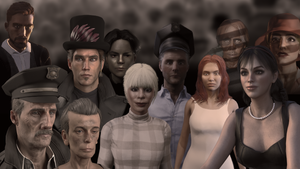
The rigid confines of both a stage and a game level also require clever use when it comes to props and sets. After all, even the most lavish Broadway production has only so many actors, props and backdrops to use. In game design terms, sets are simply rendered environments while the actors and props are modelled 3D assets. Both clever stage designers and game designers reuse environments and assets in creative ways, allowing the familiar to come across as being fresh and innovative. Take “Fable II” for example, a world populated seemingly by thousands of unique characters. Of course, these characters are in fact pulled from a finite number of 3D models, not unlike the Broadway production of “Wicked”, in which the supporting cast is often required to play multiple roles. In essence, both “Fable II” and “Wicked” are working within the confines of both a stage and a level, using and reusing the available resources to convince the audience they are seeing and experiencing a much larger world.

Both video games and stage plays are also mediums which are told entirely through action. Physicality plays a vital role in live theatre just as it does in terms of video games. If we continue the analogy of the stage as a level, stage directions are almost uncannily similar to the countless Event Triggers and GAS actions found throughout a game. A specific line from a character triggers the arrival of another character from offstage, while the closing of an act and set change is not unlike the loading of a new level or game area.  Just as in a well-designed game level, a play’s exits, entrances, events and special effects are all timed to deliver maximum impact to the audience. In this sense, good level design, much like good stage direction, is all about creating a simulated reality and driving the experience forward through the continuous and creative use of action.

What Stage Plays Can Teach Game Designers

1.) Economy: Perhaps the greatest lesson game designers can take from the stage play is the notion of economy. A stage play has a small space to work within, in addition to having a limited number of actors, props and sets. Similarly, even the largest open-ended sandbox game has only a finite number of character models, levels, environments and assets to work with. By studying the innovative ways in which live theatre utilizes multiple assets to create a larger dramatic world, game designers can learn to better reuse resources to create games that are compelling, dramatic and satisfying to the player.

2.) Working Within the Medium: A play is defined by its three act structure and its unique live nature. A good playwright or stage director works within that medium, rather than attempting to move beyond it. Indeed, as anyone who has ever seen the Broadway production of the “The Lion King” can attest to, players take full advantage of the stage, the audience and the theatre environment to create a visually engaging experience. This concept can also be applied to game development. Indeed, in the initial planning stages of game production, many designers often try overextend themselves, wanting to design games that often work against the medium rather than with it. A designer for example, might want to model thousands of unique characters and 3D assets in addition to creating hundreds of environments and levels. Yet in all likelihood a game’s development budget, technical specifications and size requirements will require creatively reusing assets rather than using them as one-offs. Much like a stage play, game designers must work within a medium that is in many ways defined by its limitations as well as its capabilities. Take Hideo Kojima’s “Metal Gear” series for example, games with an almost theatrical use of cut scenes and characters and which seem innovative and fresh despite often reusing the same assets and levels. For game development, this means taking a page out of the stage director’s handbook, creating and using assets, levels and gameplay that work with the medium rather than against it. 

Wicked

3.) The Audience: A film or television show can often take its time, directing the audience’s eye towards specific scenes, characters or objects of interest. Video games and stage plays however, don’t have that luxury. In a game it is the player who often controls the camera or at the very least moves their character wherever they wish in a specific level, while in a stage play the audience’s view is focused entirely on the stage. Oftentimes game designers take for granted that a player will not behave in a way in which they wish and must constantly be aware of the player’s expectations and potential actions. Game designers can learn from stage plays which are constantly aware of the audience in terms of the set layout, performances, lighting and even audio levels – all of which are used to maximum effect. If game designers take into consideration the notion of how players will respond in a real-time setting then the end result will likely be games which immerse the player in the world rather than working against them in unexpected ways.

4.) Stage Direction as Level Design: Stand backstage at any live theatrical production and you’ll witness a level of coordination, skill and logistical juggling that almost has to be seen to be believed. From costume designers frantically tugging on outfits onto actors, to lighting directors setting up for the next scene, to stagehands preparing for the next set change. All of it however, takes place behind the stage with the audience never aware of the seamless transition from scene to scene. The result is not unlike a video game, in which the curtain of gameplay masks the 3D assets, rendering and level design hidden deep within a game’s code. In a live theatrical production, if something goes wrong the audience will likely know, just as how in terms of game development the always dreaded bugs, hacks and exploits can threaten to snap the player out of the game world and back into reality. Game designers can learn from a stage director’s experience in terms of seamlessly managing multiple assets, creating engaging levels and developing compelling gameplay, all without the player ever seeing the technology and design taking place behind the scenes.

The famous early 20th century American actress Minnie Fiske once said that a “play is like a black forest, something you can enter, something you can walk about in. There you can lose yourself. And once inside, you find such wonderful glades, such beautiful, sunlit places.”  Her description sounds not unlike a well-rendered video game level, presenting players with an incredible world to explore and interact with. Game designers owe it to themselves – and to players – to think outside the box and draw from various mediums; whether it be film, television, novels or stage plays. In the end of course, entertaining, thoughtful and compelling experiences will always keep audiences coming back for more, whether that audience is in their seat watching as the curtain rises or clutching their controller in front of a console.


Comments

Ron Newcomb
profile image
Brilliant post. I notice the interactive fiction community has discovered this. Terms such as actor, action, scene, on/off stage, etc., are the names of the essential programming constructs in Inform 7 (http://www.inform-fiction.org). Many of the veteran authors of I-F have noted that, especially for narrative-driven rather than exploration-driven works, the stage metaphor is *the* most apt metaphor for I-F development, edging out even game design! Of course, interactive fiction is an odd beast, as it also has a novel's ability to swap scenes instantly -- even moreso than a video game and its loading requirements -- plus character interiority. It's a very interesting corner of the game design world.

I'll write more on this later, but I'll be sure to link to you when I do. Lots of good info here.

-Ron
http://www.gamasutra.com/blogs/RonNewcomb/293/


Duncan McPherson
profile image
I agree that each of the perspectives found in the traditional theater experience (e.g. writer, actor, director, stage manager, audience member, etc.) has something to teach from which game developers would directly benefit. However, I've participated in and studied stage plays for years, so I'm biased.

What is omitted, interestingly enough, is any discussion of the role of improv. Improv has even more to teach developers, in that the act of successful improv -- rather than saying "no" -- centers on an exchange of "yes, and...." Just that simple lesson itself is more pertinent to both developing gameplay and to managing teams than the lessons of theater itself. Improv has even more to offer in terms of helping developers understand fun. When something -works- -- dramatic or comedic -- it feels good. It feels constructive. It produces a sense of accomplishment. All of these things help make the experience seem fun, and when you have fun, the audience generally has fun as well.

That said, the article brings up solid points. I'd like to see more discussion on this in the future!

Ron Newcomb
profile image
Duncan: Hey you're right! I wondered about improv's omission, too. Would one (or both!) of you post more sometime about your thoughts on improv? I'm familiar with the tagline "yes, and..", but as a programmer, I know the computer's default answer is always "no". (Lack of common sense and tropes and stuff to pull from, I guess.) I have trouble reconciling them.

Jhypsy Shah
profile image
Awesome. I've been trying to promote this as well,this link is geared more towards muds and flash:

http://blogs.myspace.com/index.cfm?fuseaction=blog.view&friendId=228442601&blogI
d=479864964

I have a site in the works that is pulling it all together into an interactive game/media studio that can interact with game owners who want to add their world to the "known map" for player runs and other projects.

more will be updated in the forums @:

kingdomofyet.webs.com

Glad to see someone else has the same visions, I have ads and posts that have layed in forums since last year with the only response if any being "what?".

I have found a few old gems as well, such as an old article on here, I forgot the name (Hal?)..nice!

I was wondering if it was ok to link to some articles here. I'm trying to better organize info.

-J

Reid Kimball
profile image
That's funny Duncan (I work with him BTW) I also thought about Improv and yet we haven't talked about it together, must do that.

I think Improv is particularly relevant because it has a set of rules that ensure the improvisation never gets stuck and becomes "broken". One of them is what Duncan mentioned, never saying no. If someone else says, "Hey, superhero diaper man, how was last night?" You can't respond, "No, I'm not diaper man, I'm rubber band man." You have to go with the flow and play your part.

Though, I could be wrong, I only research Improv a little bit and have much to learn.

Sean Weiland
profile image
I was so thrilled to read this blog! I have my BA in Theatre and am about to start in a graduate program for Game Production and Proj. Management. People always look at me funny and ask how I could make such a random leap. The truth is the two are very similar and my personal goal is to bring theatre/theatricality into the video game development process.

This blog rings very true to me. Everything from the similarities in the design process, to scripting, even the management of resources are very similar. I don't think it will take long for theatre to influence the way games are developed and presented. More and more people are/will start to see that the elements of good story telling and grabbing the audience's attention are what will be necessary to make good video games. I do realize that this is applied now, but as the beginning of the article mentioned the influx of television and film professionals (many of whom have theatre backgrounds and will bring their theatre friends) will further develop and refine the video game experience.

I read the comments and agree that improv can be a powerful tool in the development and management processes, but I think that may also be why it was omitted. In theatre improv is a tool (or game, or method) for building ensemble or reaching other goals. It has also branched off to become its own form of presentation in theatre, but generally is a tiny facet of theatre. The analogy of theatre that is being used in the main article references the more broad aspects of theatre and is probably why improv was not mentioned.

This has been very interesting to read and I hope more come of it.

Ron Newcomb
profile image
Sean: yes, even the renowned interactive fiction (text adventure) author Emily Short has remarked how much more our little prose games resemble theater.

Or to be more correct, how the construction of them resemble theater -- the computer is the überstagehand, shuffling props around for specific scenes, directed the NPCs what to do and where to go, all in the blink of an eye. Though we create characters, props, and settings with an eye toward economy (as in the above post), we can at least reset the stage instantly, like a novel.

It's really quite exciting, and I'm been nosing around ancient Greek plays, reading Aristotle, etc., because of it all.

BTW, what does "building ensemble" mean? Inquiring minds want to know.

(Adam, it's up: http://www.gamasutra.com/blogs/RonNewcomb/20090418/1184/Merits_of_an_Old_TurnTak
ing.php)


Jhypsy Shah
profile image
http://kingdomofyet.webs.com/apps/forums/

Sean Weiland
profile image
Sorry I didn't get back to this thread sooner.

I love the analogy of the uberstagehand. Its very true, and an even better part is the computer is less often late :).

Building ensemble: On a basic level it is team building in the theatrical environment. As you may be able to imagine, when it comes to performers there is a lot of ego and/or self consciousness. A fairly large portion of the first few weeks of rehearsal process is dedicated to the process of building a sense of ensemble (an ensemble cast). This involves simple "getting to know you games" to exercises that get an entire cast moving at the same time on stage. The process helps performers put egos and normal social defenses aside. I believe the phrase "building ensemble" is used because even after the first few weeks of concentrating on this team building process, it is still reinforced with at least one activity every rehearsal. Literally continuing to "build" the connection between the actors. The end result (if all goes well) is a group of people that can function as one on stage.

Most theatres rehearse for about two months before a show goes up (give or take two weeks). There is so much to get done in that short amount of time, but no matter how hard the technical crew might work if the human (actor) element isn't believable the show is pretty much a bust. That's why building ensemble is important. It is also why "theatre folk" seem to become so intimate and attached so quickly. A moment on stage can become much more meaningful to an audience when they see two characters connect, and the best way for them to connect to know each other.

Well that was much longer than I thought it would be and I am really only scratching the surface. There is come really cool stuff that ensemble work can be applied to and that I've seen done. If you have any other questions give me a holler.


none
 
Comment:


UBM Techweb
Game Network
Game Developers Conference | GDC Europe | GDC Online | GDC China | Gamasutra | Game Developer Magazine | Game Advertising Online
Game Career Guide | Independent Games Festival | Indie Royale | IndieGames

Other UBM TechWeb Networks
Business Technology | Business Technology Events | Telecommunications & Communications Providers

Privacy Policy | Terms of Service | Contact Us | Copyright © UBM TechWeb, All Rights Reserved.