Latest News
spacer View All spacer
 
March 16, 2010
 
Stardock's Wardell Details Impulse Reactor Specifics
 
Microsoft, Nintendo Successfully Defend Controller Patent Allegations
 
IGN Lays Off Staff In 'Every Part Of The Company' [1]
spacer
Latest Features
spacer View All spacer
 
March 16, 2010
 
arrow Free To Play Games, Meet The Virtual IOU [10]
 
arrow NPD: Behind the Numbers, February 2010 [4]
 
arrow Your (Brief) Guide To GDC 2010 [4]
spacer
Latest Jobs
spacer View All     Post a Job     RSS spacer
 
March 16, 2010
 
Red 5 Studios
Senior Level Designer
 
Silicon Knights
ENGINE PROGRAMMER
 
Pixar Animation Studios
Image Mastering Engineer
 
Gameloft
2D Sprite / Pixel Artist
 
Backflip Studios
Game Artist 2D/3D/Mobile
 
Insomniac Games
Gameplay Programmer
 
Relic Entertainment
Associate Producer
 
Edge of Reality
Flash UI Artist
spacer
Blogs

  Production or Destruction? A Quick Guide To Project Management
by Filipe Teixeira on 06/27/09 03:22:00 pm   Featured Blogs
9 comments
Share RSS
 
 
  Posted 06/27/09 03:22:00 pm
 
First of all, let us say hello to all the members, since this is "our" first post here. And that I recommend that you first read the following article by Denki's Colin Anderson at this link: http://www.gamasutra.com/blogs/ColinAnderson/20090616/1890/Creative_Assembly_Lines.php


For an extra tidbit of context, this comes out of a suggestion after Colin's review of my comment in his entry about the forementioned article at Denki's new website (and it looks sweet! If you haven't seen it, drop by at http://www.denki.co.uk and share some love!).

Anyway, instead of just pasting a copy of my comment, me - Filipe Teixeira - thought it would be cool to get with my old friend and professional colleague, Gabriel Evangelista, since we extensively have already debated this theme and believe it deserves special attencion also. So, this is pretty much a synthesized report of our mutually accumulated experience in around 12 years of professional experience (part of them in team-ups or with us ending up switching as each other's bosses, on different projects/ocasions, fun!). This also refers to several fields, not just games but appliable in companies in general.

Succintly, Colin was trying to consider if there was a way to maintain “Creative Assembly Lines “ , specifically in the games industry, where you could keep a constant and periodical flow of products whilest mantaining viable quality and also being able to assure an almost dead on sales hit.

He gave excellent examples like Pixar and Motown Records.

Here's what me and Gabriel have come up with in our own little coffeeshop brainstorms:

- Quoting Ed Catmull:

“If you give a good idea to a mediocre team they will screw it up; if you give a mediocre idea to a great team they will either fix it or throw it away and come up with something that works.”

Couldn’t agree more…

I belive that the more important part (right after getting the best team possible), is in pre-production… Really guys, just start to think things through before getting full steam on a half-baked project… It'll save you a lot of time and money (and specially a mob of angry artists), if you actually know what you're doing, how you're doing it, and when it's for. Take the necessary time to do this! However, that doesn’t mean that if you have a good idea, it can’t be saved for later use if you can't do it now in the way it was envisioned. But you always have to prioritize something! It's also equally important to insure a steady income flow, of course, instead of burning all of your budget and companies' resources kicking the same dead horse over and over. But I digress...

For example… The “mythical lunch”, when the Pixar team just babbled away with dumb ideas across the table, amidst a jungle of sodas, fries, and colesterolic burgers. Most of all, if not every one – don’t recall quite well, would have to check my copy of Pixar’s short movies – , ended up as a blockbuster movie! (if the expression isn't suitable, be nice, this is not my native tongue)

I see this happening for two reasons:

1st – Creative freedom, a good base concept, and a very, very, VERY well defined context later on.

They were having lunch and joking around. No stress, no pressure, just having fun! They were being themselves and intuitively letting out that piled up stuff that their collective personal/professional/artistical experience told them that was so originally strange that it just had to work given a chance. If it got them a good laugh, it pretty muched sticked with them. Although, you still have to consider the potential for chaining even more good material onto said approved idea, in order to create a really good story that makes people love it as much as you; either by ways of argument or visual storytelling (preferably both – Wall-E anyone?) Remember that we all still have that primordial need of listening to stories around the campfire… Change the campfire to a movie theater (or a living room with a game console/pc), and the outcome is pretty much the same.

2nd – Previously amassed technical experience. They had a lot of technical skills knotched under their belt as 3d developers/animators, so you can say that they mastered the means as well as the message… But this is the thing: they didn’t rushed head on to all the projects at once just because one day they had found out that they could make a better shading plug-in that in the previous day.
They gave it time, to when the right technical skills could be used to develop the right story and with that, allowed the story itself to be matured (much like you do with a good wine). And during that time, they were also learning from mistakes made / feedback received from previous RELEASED projects. INCOME is the key word, along with EXPERIENCE again.

That being said, they prioritized their work. “What can we do best with what we got?”. That's the secret! Don’t try to do the best product in the market ever; just do the best you can do. Otherwise, you’ll always be focusing in other people’s strengths and successes that may or may not be your own. Most of the cases I've personally met, the companies were not even in the same league of their self-pronounced “competitors”... I can't stress this enough: If you’re an excellent wood carver, don’t try to succeed with a blacksmith gig…

It’s equally important to know yourself as much as the market, and to know what you can truly offer. Nobody necessarily sets out to make a list of certified published hits. What you must set out to do is a product that is accurately well developed to the best extent of your current abilities, and of a well conceived thought process. If it is something of real quality, then it’ll get a life of it’s own when it hits the market. Like Colin said, at this time in history, there’s no need to push bad products with lots of shady marketing tactics anymore… The internet became the best vehicle for publicity ever. People talk easily of what they like or not, you just have to light the right fuse. And when it's lit, the flame spreads quickly enough.

Sure, you can try the - almost - easy way and produce something from an already known brand like Transformers, X-Men, or Dragonball. But we all have to admit, several times, those “adaptation” games are poorly developed... Not necessarily on technical terms, but more in conceptual terms.

Several companies don't really know how to handle the brand or the context that the brand is inserted and neither do they really try, either out of a bad timeframe, or out of sheer uninterest of the product... So you end up with something that is just visually appealing at best, but it's just another one of those “run o' the mill” products that no one will remember in a month's time. We've seen this not only with games alone, movie adaptations can be extremely poor, and so the merchandising. There are a lot of toys out there that simply don't match the brands (trust me, I've seen enough bad Spiderman and Wolverine figurines with respective lame box art to make me go bald). Sure... The game will probably sell a lot, but that will unduely be about the legions of fans of the brand that will want to be a more direct part of that universe (much like what happens with Star Wars fans), but they'll probably end up feeling cheated out of their money pretty quick and never consider purchasing another product with your name on it ever again.

Remember this, fans never EVER will let you get away with you messing up something they love, so don't try to be a smart ass and think that you'll be able to pull it off... There is no such thing as easy money; these sorts of games will require as much homework - or even more - as any other project development. Another thing that we both consider this being a bad sort of project for the unexperienced / reckless team is the fact of how seasonal these types of games are. They're most likely to sell more if they're connected to some sort of a special event, like a movie release.

I believe that's unnecessary to tell you how bad this is for your company... Simply because the gazillion bucks you might have made from such a title, won't last forever. Still... Remember what I've said, nowadays people care a lot more with reviews due to them being much more acessible via internet and that there are a lot more of credible reviewers out there. So, fans will be more likely inclined to see what you've done with their little piece of “devotion” before ever purchasing it, which means that the product might not even sell well at all.

So, back to the original subject - what can increase your chances of having a real hit in your hands? Here go a few tips:

1st - BRAINSTORM!! Study the subject as much as you can! Talk about all that you know and speak your mind! Don't be shy and jumble out all the silly ideas you have. Most won't stuck, but the ones that do, will be winners for sure. Being from latin origins, we recommend a cool coffeeshop or a restaurant, nothing fancy. Basically go talk in a place were everybody feels comfortable... Like a rec room. A few years back I've heard of a very succesful comics company that had their weekly meetings/brainstorms around fussball tables, arcades and lots of cheesy pizza's!

2Nd - Good planning/management! Again, think things through... Know what your teams potencial is! Know their professional work as well as you know their personal work as well... Hobbies are also important since they reveal skills that are quite useful. Define tasks, who leads who, who does what, what needs to be done in a specific timetable. Don't rush it necessarily... Make it so that the project can be done without the strain of a constant crunch...

It all starts with game design. If that sucks, the whole project will likely suck too... So let the game designer do his job and don't be nit picky about it. It's what he's good at, so don't be stumbling in throwing your half baked ideas you came up whith when you woke up to go to the toilet in the middle of the night... That part stays on the brainstorm. This is valid for artists, modellers and programmers too. They're professionals, if they're even half good, they know that they must follow through on their tasks. They'll also know that there are always room for improvement so they'll be flexible enough to accept changes as long as they're reasonable.

If it really is needed to work with a tight deadline, remember that a good team leader must be a good motivator. Cracking wips and threats of unemployment only make the team to jump boat on the first possible chance. Been a producer myself (and son of one too), so I know that sometimes we must be hard to get the job done... But there are ways of doing that. Encourage their work and let them know that you're happy with their efforts, and work side by side always. If they have to stay in, you stay in as well. It shows commitment and loyalty. Remember, you spend more time with your coworkers than with your family and friends... It's important that the company is a family as well... not just a job. People aren't machines, if they are under too much stress, they can't perform their tasks well.

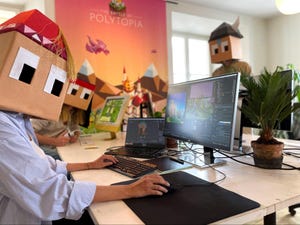
3rd – HAVE FUN! You're making things for people to enjoy themselves... If you don't, what makes you think that they will? This must be a constant at all times! If someone brings a cool gimmick, or the ocasional lunch break nerf war, it's an excellent moral booster... Heck, the kind of laughs you get just because someone is using a transformer's bumblebee helmet whilest working, goes a long way for clearing the stressy environment. So if possible, organize paintball games, walkabouts, barbecues, anything... Not only those are good morale boosters but they also strengthen the bonds of the team too.

Of course there is no need for to be guys jumping up and down on the desks... Everything must be done with good measurement. But a creative team is always very active, and this is a creative medium, not a lawyers office - apologies to the lawyers! - So, harness that creativity and make it grow! It's a sure deal to have fun games...

So, these are just a few ideas that we thougt that were relevant from our past experiences, and we hope that they can be of some use to you!

Take care!

Badger & GEvan..

_________________________________________________________________________

- Filipe and Gabriel are two 2D artists currently living in sunny Portugal, with published works in games, comics, and several editorial projects.


Comments

James Wiggs
profile image
Nice article!

Filipe Teixeira
profile image
Thanks James!

There's a lot more to be said... But, we think that we summed up at least the more important aspects... But, it's only our point of view =)

Thanks once again!

Mohit Punia
profile image
Men are not Machines! Great job with the article, really felt personnel because I have actually experienced some of the mentioned stuff (bad ones & some good ones). Very few company actually play to there strengths, they just go by the approach, "Let's do what they did.....but better!"

Colin Anderson
profile image
"Don’t try to do the best product in the market ever; just do the best you can do. Otherwise, you’ll always be focusing in other people’s strengths and successes that may or may not be your own."

Amen to that one! In fact, now you mention it, I think you've hit on another one of the fundamental pillars of any creative undertaking.

I'm really glad the "Creative Assembly Lines" blog motivated you to go to the trouble of documenting your own thoughts on the creative process. Understanding the creative process, and particularly the creative process with respect to teams, is one of the biggest challenges facing our industry today. We need to be discussing topics like this more if we're going to improve the products we make, and the way we make them.

It's all too easy to focus on discussing the technology in games development - it's easier to quantify for a start - but the real, long-term improvements in games development will come through learning to harness the creativity of teams in a sustainable and predictable way, not simply by pushing more polygons around the screen. Oh, if only it were so simple!

Your discussion provides lots of interesting observations, clearly based on hard-won experience. Thanks for taking the time to share them - you've certainly given me plenty of extra ideas to think about as we continue to refine Denki's development process.

And double kudos for publishing in a second language - as if the topic itself isn't difficult enough as it is! You guys are hardcore! ;-)

Cheers,

Colin.

---

Filipe Teixeira
profile image
Thanks a lot Colin and Mohit!! And thanks to Gamasutra for considering our small contribution worthy of noticing...

- Mohit:
The approach on:"Let's do what they did.....but better!" isn't that much off, remember, if you can really do better, it's ok... Like we said, the company needs steady income to work. However, the glitch might be if you don't really think on how you can do better, and end up with a standard clone. =)
So... it's all a matter of strategy!

I know that it's hard to know the assets available to you in in large companies, but, that's what the leads are for. It's all basically about good communication I guess.
Thanks again for commenting ;)


- Colin: You're right, these are first-hand notions from our past experiences, and not all of them pleasant! But, we have also a lot of funny stories coming with it also, so, no regrets!
Anyway, if you think we're hardcore now, wait until we finish our studies in the Japanese language! =D

Mac Senour
profile image
I heard a great quote from Michale Jordon. After a game where he scored some massive amount of points a reporter asked him what was different that night, than the night before where he played the same team but didn't score many points.

He said: "I dunno exactly, but tonight I just felt more comfortable out there, more relaxed".

I think about that every day, people do their best more creative work when they're relaxed. That means not stressed about the work they're doing, but also about life in general. They're not worried about their job, they're not worried about their relationships etc. They're happy and relaxed. which I think speaks to your point #1 and #3.

I talk all about this stuff in my blog...

http://aboutmakinggames.blogspot.com/

Mac

ken sato
profile image
Interesting article. I think what's clearly critical is the communication/interaction framework. I've seen many creative groups get lost in the wild and programming teams work with incoherent expectations.
Pre-production wise, this can't be stressed enough. Removal of key points of uncertainty lets you get more adaptive, not less since you have more bandwidth to deal with them. This applies to dates, features, functionality, contract agreements, and so on. Get a structure in place, confirm the critical paths, get dates a key points, and make sure the visibility on extends to the planning horizon.

Good article, now that I have a chance to think about it writing this.

~Ken

Filipe Teixeira
profile image
- Mac:
Undoubtly they do their best creative work when relaxed. And we all know that a human life, any human life, is filled with a multitude of aspects that influence us in many ways. However, at this article we stress only the necessary organizational and planning skills that are needed specifically to also minimize when a team member is "not up to it" due to any particular motif. The point here is to help bring about the most of the team's potential to the surface, and correctly apply it; instead of just "winging it". Remember also, a good professional is someone that can balance his professional side with his personal side. Me and Gabriel, for example, there have been some very hard times in our past, but we still got our job done. To simply put it, the techincal skills are there all the time, and creativity... well always there too. Creativity is not a matter of whim, but a byproduct of amassed knowledge and experience that is always present. But I'll talk more about it in another article.
Thanks for the comment!! I'll give your blog a close read soon!

- Ken:
Yeah... That's another problem. Most of the place's we're I've been, there is no "team"... at best there are "teams". The global view is not taken into account. Programmers program, and artists... well... they are there to serve to the artistic whims of programmers or whoever is leading the project. Which is something that greatly annoys me... I've spent two years in the company, working side-by-side by an award winning team of animators, and other artists... But our overview was never taken in account... We were "art makers". Simply put, many things that we did on demand by our boss or lead we're never gonna work and when we politely stated that fact, the usual answer was "shut up and do your job". Of course, a couple of weeks later, all the things we're sent back due to the same problems we stated before. The end result? The entire team got canned just because we knew how to do our job a lot better than the management. But this is another post all by itself.

Succintly, yes. Good planning involves good knowlege and professional freedom to you perform your appointed tasks, and all of this needs extensive communicational skills!

Thanks for commenting!

Bruno Patatas
profile image
Well done guys! Brilliant post.

Cheers,
Bruno


none
 
Comment:


Submit Comment