My Message close
GAME JOBS
Latest Jobs
spacer View All     Post a Job     RSS spacer
 
May 20, 2013
 
Giant Sparrow
Art Director
 
Red Storm Entertainment, a Ubisoft Studio
Online / Networking Engineer (Back End)
 
Curriculum Associates
Senior Producer/Interactive Producer
 
Red Storm Entertainment, a Ubisoft Studio
Online / Networking Engineer (Front End)
 
g-NET Media
Engine Programmer - CryENGINE Camera Tools
 
Game Advertising Online
Account Executive - Game Advertising Online
spacer
Blogs

  In Defense Of Non-Regenerating Health
by Megan Fox on 07/23/11 11:25:00 pm   Featured Blogs
25 comments Share on Twitter Share on Facebook RSS
 
 
The following blog was, unless otherwise noted, independently written by a member of Gamasutra's game development community. The thoughts and opinions expressed here are not necessarily those of Gamasutra or its parent company.

Want to write your own blog post on Gamasutra? It's easy! Click here to get started. Your post could be featured on Gamasutra's home page, right alongside our award-winning articles and news stories.
 

[see more from Megan Fox at her primary site, Glass Bottom Games]

Another blogger on Gamasutra (Josh Bycer, here) recently made a post focusing on the merits of regenerating health.  This is meant as an answer to it, more or less, and started its life as a comment reply that quickly grew to post-sized proportions.  He makes some excellent points, and it's definitely worth a read for any designer considering their options when it comes to health systems, but, I must disagree... sometimes - as you see below:

The problem with regenerating health isn't that it has changed world map design from the classics (not sure I've ever heard that argument, actually) - it's that it removes from the player the onus to advance, or more generally, rewards a plodding, methodical approach to combat with a great deal of crouching behind walls.

Now in a cover based shooter, is this a bad thing? No, not really. The flow of a cover-based shooter swings from cover to cover, with a stop-and-pop at each. There are natural breaths at each cover spot that make sense as a regeneration point, and implementing health pickups there would make little sense. When you're out of cover, you're typically being shot, and thus not regenerating - you only regenerate at the cover points anyways. So all this does is frees them up from dropping a health regen item at every single cover location in a level, and thus allows the player a bit more freedom in planning their assault.

But putting cover based shooters to the side, what does this do to an action game that wants the player to rush, to drive forward, with a continuous flow broken not by bullet obstructions, but by the depopulation of each enemy group? By definition, if you're unwilling to let your player run away, you've now got to balance your health pool such that you can absorb enough damage to survive a group - and that almost never works, for any kind of decently large group. The regenerating pool gets so big that you can easily stand in front of an enemy and leisurely kick them in the shin until they expire, and if you're running low on health, hey, just duck behind a wall. So you try and balance that by increasing the length of time in cover before regeneration can occur, or by slowing regeneration? You just made the game easy AND irritating, since now the player does the same, but has to sit in cover an absurdly long time. You also just increased the necessary spacing between enemy groups.

Regenerating health in this framework turns the combat into a game of hide and seek, and quickly becomes absurd. You almost have to slap a comical voice actor onto your character (Nathan Drake in Uncharted for instance ;) ) for the slapstick running into fire then running back out to make any sense at all.

Now consider non-regenerating health. This allows for as large an enemy group as your health pool allows, and puts the onus on the player to survive the group, using any and all abilities they may have. It does not reward hiding - instead, it rewards efficiency, since the faster you take the group down, the better your survivability in the next encounter. If that proves too challenging? It's easy to fix by peppering the paths between groups with additional health pickups, and you can even scale those based on difficulty or how well the player seems to be doing. You have all the design tools you need to precisely control the player's level of tension, and their risk level in general (and their reward following that).

It even lets you extend the combats to much larger than what a single healthbar's worth of damage will get you, by the simple inclusion of spawning powerups in mid-combat. The easiest and most classic way of doing that is spawning powerups from defeated enemies, a technique Metroid pioneered to great success. You can even peg the the level of the powerup spawned to the difficulty of the enemy, to better balance how much health you get based on the difficulty of the encounter just survived.

... and you get all of this without ever asking the player to interrupt game flow and go hide in a closet.

Now some games do a sort of hybrid approach - regenerating overshields protecting non-regenerating squishy bits - and it does help, but it still shifts the gameplay flow.  What you're encouraging now is efficiency with dodging, where the player is likely expected to push through combat as effectively as possible, but while dodging and weaving in and out of cover.  In some gameplay styles, this makes sense (Chronicles of Riddick is certainly a good example), and it often has the effect of ratcheting tension even higher given how few discrete units of unrechargable health you typically have.  It still isn't the best choice in all cases, though - such as in a Ninja Gaiden or God of War, where you want the player to go all-out, ducking and weaving only to quickly position themselves for their next attack.

Still others effectively do pickups - but mask them.  As Josh mentions, in Infamous for instance, you get a bump for getting headshots (with positive Karma), and can recharge energy in combat.  The key here, though, is that that is not regenerating health - that is a health pickup that's been integrated into the core design in a more logical fashion than a literal health pickup.  It is a discrete point or powerup gained through specific player intervention.  The headshot in particular is effectively a powerup drop on enemy death, just without rendering the drop / designing to allow "picking up" the drop even if the enemy was killed at a distance.  Similarly, the recharge points are health packs that require a button hold to pick up rather than simple proximity. This is excellent, and works well, but it needs to be kept clear that this is very different from regenerating health, and has an effect on play flow nearly identical to the classic health pickup approach.

As such, you need to carefully consider your game's genre and desired flow before shoehorning in a health system.  Some (few) genres do indeed work well with regenerating health, others work well with shields over non-regenerating, and still others work best with no health regeneration at all.  You also need to consider the time you have to balance the system... fully regenerating health is easy to toss in and get mostly right quickly, but unless it's the right genre, the resultant play experience will never be as tight and thrilling as the same done with carefully designed non or partial-regenerating health.

So, like I said.  It's a good choice... sometimes ;)


Comments

Josh Bycer
profile image
"But putting cover based shooters to the side, what does this do to an action game that wants the player to rush, to drive forward, with a continuous flow broken not by bullet obstructions, but by the depopulation of each enemy group? By definition, if you're unwilling to let your player run away, you've now got to balance your health pool such that you can absorb enough damage to survive a group - and that almost never works, for any kind of decently large group. The regenerating pool gets so big that you can easily stand in front of an enemy and leisurely kick them in the shin until they expire, and if you're running low on health, hey, just duck behind a wall. So you try and balance that by increasing the length of time in cover before regeneration can occur, or by slowing regeneration? You just made the game easy AND irritating, since now the player does the same, but has to sit in cover an absurdly long time. You also just increased the necessary spacing between enemy groups."


With action titles,it depends on how the regenerative health is implemented. Doing it continuously as you mentioned would be imbalanced


Awhile ago I wrote up a design doc for an action game (one part virtual fighter, ninja gaiden and godhand.) In the doc I thought up three different health systems. All item base, regenerative to a point, full regen when not in combat. With the level of complexity I was shooting for, all item based would not work as having the player have to worry about ending a fight with enough health for the next one would make things to difficult. The same for regenerative to a point.


For the idea I wrote up that the player could regenerate health when not in combat, slowly during a fight and rapidly after a battle. The reason is that for the game, I was throwing in advance fighting game mechanics such as a multiple counter system and unique enemy types. By using this system, it would leave me free to create situations that would be just unfair for a normal game.


I agree that regenerating health is not the "be all, end all" answer to design. The experience the designer is trying to create is the biggest factor.

Megan Fox
profile image
Agreed. It absolutely depends on the game in question.


Also, your game design sounds fun, at least in brief. Did it get released, or was it an abandoned idea / cancelled / still in progress / etc?

Josh Bycer
profile image
It was something I started writing during college, but I haven't found a team yet to put it together. Right now it's on the back-burner with a few other grandiose ideas I've had :)

Gustav Dahl
profile image
Great reads from both of you :)


Another interesting use of health points is seen in racing games such as F-Zero GX and Excite Bike/Excite Truck, where you can choose to sacrifice your health for a temporarily boost of the vehicle. If you use too much, you crash, but if you strategically use some of it and wait to refill at certain places (or knock out other competitors) you gain a special flow unlike no other racing games.


I also find the "second chance" gameplay mechanic quite interesting. One of the first games I remember using this system is the Zelda series with the famous bottle fairies. Today, a lot of shooter games use a similar mechanic where, instead of killing you, you drop to the ground waiting for a teammate to come and rescue you, before you screen slowly fades away.


I also need to mention the EarthBound/Mother games where your health isn't drained straight away, but when an enemy hits you, the damage will slowly impact and roll down (like a slot machine). This adds tension to the battle system, as well as making it possible to the player to do just one more attack before dying (or you could also quickly eat something tasty and save yourself from death).

Daniel Gooding
profile image
Ah Earthbound, and those crazy exploding trees. For the longest time I wondered why I would exit a battle with minimal damage from a tree suicide.

Jonathan Jou
profile image
Great article! I think you're absolutely right--health management is a very important part of player experience, and if you aren't conscious of the results of regenerative (encourages hiding), static item-restored (encourages tactical movement to manage health), or any other combination, you can change the game without realizing or understanding what's gone wrong.


I think it's more valuable to see "health" as the "Game Over Resource"; when this meter hits zero you have to retry the task at hand, or maybe more. As Gustav says tying the risk of losing the game to tangible benefits like temporary speed boosts or maybe powerful attacks sculpts the player experience dramatically.


What plays into that delicate balance is without question a defining aspect of any game, so yes, in the world of cover-based shooters, where a few seconds of fire is lethal and a few seconds of cover buys you back those seconds, it works perfectly. In action games where you *want* the player to barely survive an encounter, and have to live with that through the next ten fights, it certainly makes the game more difficult to complete. So instead of starting with "which health system makes sense," I think it would be better if developers considered "how often do we want the player to fail, and for what actions" and tailored the game overs to match that vision.

Daniel Tari
profile image
Of course. But it is becoming common regeneration of life. And hence the low difficulty. In games such as RedDead:r regenerate life was a design mistake.


Other games as CoD is half wrong, should be a life bar that regenerate to some extent, passed that point must heal you with first-aid kit. The last Halo demonstrate that you can get a more balanced difficulty, fun etc...

Sting Newman
profile image
Regnerating health = dumbed down gameplay. It's there to take away any challenge at all while trying to keep the "excitement". You get bursts of action like in halo before you go hide and recharge your shield.


Halo set first person shooter design back ten years. When even duke nukem forever has a two weapon limit and regenerating ego (dukes life) there is a serious issue with game design.


Unfortunately too many game developers have lost the theory behind games and have gone for pushing players through content at any cost. Every game developer has done this. The most guilty parties are the MMO makers like blizzard. They've come up with a massive tonne of bad design and it's filtered down to other games.


Things like conserving ammo, strategically getting to placed health packs/repair zones... doing a run through a huge mob of monsters to make it to the next level before your health runs out. All those kinds of things were obliterated by regenerating health.


It cuts off a whole range of emotional tension and reward for making it while being 'near the edge of death'.

Eric Schwarz
profile image
I'm kind of the opinion that modern shooters have been significantly harmed by regenerating health. I certainly don't mind a few games with it, but combined with the common two-weapon system introduced by Halo, it's really hard to integrate satisfying attrition into a shooter.


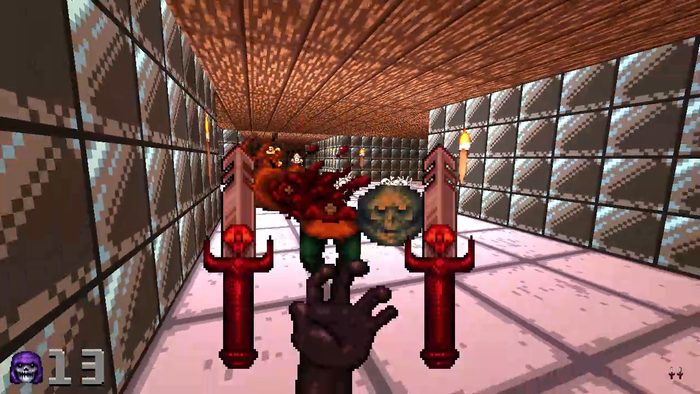
This has a negative effect not only on the game (progress is, as you mentioned, consistent and plodding, rather than paced with rises and falls in tension as the player is more or less equipped), but also on level design. There's that image floating around the Internet comparing level design in Doom to a modern shooter, and while it's a bit tongue-in-cheek, it's quite correct in that level design has since become significantly more straightforward. This isn't necessarily out of a lack of respect for players' ability, but rather a lot of it comes down to developers now crafting experiences which are designed to move only one way - straight forward. When there is no health to manage, no ammo, no hidden weapons, no secrets, then there's no need for anything but the most linear of paths to the next set-piece.


Another art that I think has been lost in shooters is systemic or strategic attrition. My favourite example of this is in Half-Life 2 - the game does an excellent job of giving you just enough health and ammo to feel confident, without being overconfident. It's rare to be completely full up on everything, and there are stretches where you'll definitely be wary of proceeding forward. These carefully-calculated "random" item drops are what keep much of the tension throughout the game so consistent, resulting in natural highs and lows at just the right places. It's been a long time since I've seen a shooter which displays this sort of system with any sort of grace or finesse, much less at all.

Brandon Battersby
profile image
I have to disagree that Health Regen encourages a "plodding." To me Health Regen adds an ebb and flow to combat that I find quite natural and encourages another pillar of management. And what's wrong with a methodical approach. Even fighting games (traditional health bars, Soul Caliber), players develop methods and techniques for combo chains, and favor characters because they develop a play-style.


In shooters, players do the same. CoD, players love to run and dive. Also ask any PvP Gears player. Cover is more about movement than health management (almost like chess with guns). Even if a player is forced to retreat, they are heavily pursued, usually before health Regen kicks in. Players rely on team mates for cover, and movement tactics (not a hide and seek tactic).


One of my critiques of many RPGs, IS having to use items or hit the rest button after near every encounter. To me, that creates a "plodding," and break in continuity of an adventure. I find myself resting 4 days of game time in a single dungeon... where that would me certain capture in reality.


In regards to action games that utilize Health Regen, I've never seen them. Can someone enlighten me to where this mechanic has been used in a game like Devil May Cry, Dante's Inferno, Ninja Gaidan, etc?

Josh Bycer
profile image
Ninja Gaiden 2 did have partial regenerative health. If my memory is correct I think it was along the lines of Chronicles of Riddick, that Ryu's health was segmented and would regenerate to a point.

Brandon Battersby
profile image
Did it hurt the game? I didn't even notice, and I played every game of that series.

Brandon Battersby
profile image
Sorry, let me clarify. Many of you make points about how this fails as a mechanic of a game. Yet I can't think of any games when Health Regen is implemented improperly as you mention. Maybe if you (Josh), Christian, or Megan, can share examples of games they played when this system failed the dynamic of a game.

Megan Fox
profile image
I can't speak to the regenerating health in Ninja Gaiden 2, but I can speak to NJ2's balance being off overall. It was widely regarded as the weaker in the series. Now is that entirely because of the regenerating health? No, I assume not, but who knows, might have been a component.


What you're asking for overall is a bit of an impossibility, though. A game's dynamic is set by the time it reaches you, and so long as it has any polish, has been built around that dynamic. This question needs to be answered more at the beginning of design, and will influence the resultant dynamic.


A better question would be "how has this system changed the typical dynamic of shooters in recent years," and the answer is obvious - look at the number of cover-based shooters dependent on popping behind cover to heal up. Look at the general lack of difficulty settings that seem well-designed. Look at how many modern games require you to run in circles between boxes until your health regenerates enough to finish a boss fight that went south midway through. Etc.

Brandon Battersby
profile image
How is that different than focusing on Healer/Casters in RPG to save on in combat, or Spec in health steal/armor in action fighters. Ninja Gaidan and Dante's Inferno both have easy win conditions when you purchase certain character abilities. Youy can button mash your way through the game.


"Look at the general lack of difficulty settings that seem well-designed. Look at how many modern games require you to run in circles between boxes until your health regenerates enough to finish a boss fight that went south midway through."


I haven't seen many. Unless I am oblivious, the main games with Health Regen we've been mentioning have many difficulty variants and the mechanic is nerfed in PVP.

Harold Myles
profile image
I like the discussion.


One good thing I will say about regenerating health is that it gives control to the player, control over difficulty. They can choose not to slow and actually try to push through without taking the regen break.


However, I agree this is usually implemented horribly. Primarily due to a lack of incentive to 'Push On.' Making taking a break the smart option, hence slowing and dumbing things down.


But lets look at another system that i think would be interesting mixed with 'Regnerating Health'.


In the Dynasty Warriors series of games the player has a health meter and a Musou Meter. The Mosou meter provides the enegry to do all your powerfull special moves.


The generation of Mosou is based on getting hits and doing damage to enemies. As well it is tied to the level of the Health Meter. At full health Mosou does not auto-generate. You must attack. However, as Health gets lower Mosou starts generating. At the very lowest health the Mosou bar is filling almost instantaneously.


So at the lowest health, when one mistake will end the game, the player's character is at the highest capability.


The creates an interesting dynamic. Hi risk (Low Health) results in Hi reward (Lots of Mosou). The way the player regains health is via power-ups dropped by slain enemies (as discussed in the article). The interesting thing about this is when the player chooses to avoid the power-ups and NOT consume the health kit in order to remain powerful due to lots of Mosou.


The game becomes a choice for the player: How low of health CAN you play with and for how long, in order to be as powerful as possible.


I think a regenerating health system could work well when combined with a potent incentive.


There are other examples of this. Like the original X-Wing game. You could route, on the fly, power into regenerating shields, engine, or weapons. But not all of them. It allowed the player to choose the difficulty/strategy.

Gil Salvado
profile image
The second last paragraph says it all. It depends on the genre and the form of flow you would like to achieve in your game design.


I can only think of one all-purpose solution for a health system in shooters - no matter fps or top-down or whatever else you can think of - which supports the core game mechanic of the genre. Receiving health by dealing damage and a bonus boost for defeating a target. But this mechanic does not back up a certain game flow, but rather only one. Straight and forward rushing.


In my opinion regenerative health and cover-based shooting have become more of vogue type of game mechanic. Unless you really can improve it, you're just doing a clone no matter of any good intention you might have had.

Aaron Truehitt
profile image
I think the main point is distance to health. In older games, a health pack was required to earn health back, which were scattered through out a level. You made some stupid mistakes along the way, so you prayed for a healthpack around the corner. You did your best to avoid fire to make it to the health so you can put your mind at ease that just maybe you might be able to finish that level.


With regenerating health, the gameplay is now to give your HP back at any point you are not being shot at.


In my opinion, it might be best to meet in the middle with these systems. I think Halo 1 used a hybrid like that if I remember correctly. I'm not saying it's perfect though.


I don't think health regen should be thrown away, but we can clearly combine these into something interesting.

Eric Schwarz
profile image
So you're saying that having tension and uncertainty in a game is a bad thing?


I actually have to wonder if part of this comes down to the clunky controls brought about by gamepads. A mouse and keyboard is a precision instrument: you're able to move with finesse and accuracy, able to react quickly without error, etc. With a gamepad, I always feel like I'm piloting a mech suit rather than a living human being, and I bump into walls and stumble around accordingly. Managing a finite reserve of health is almost impossible in a console shooter because it's so difficult to move precisely and avoid taking damage... by the time you have a chance to react and hide behind cover, you've likely already taken a dozen bullets to the face. Combine that with those "only 3 HP left" moments commonly seen in older shooters and regenerating health mitigates a lot of unavoidable frustration and even no-win scenarios.

Christian Rivers
profile image
Being a console gamer, I have to say, I feel the opposite. The keyboard is clunky. Anyway this is not an issue, as whatever your preference is will always be useable to you.

Harry Fields
profile image
Sounds like a bunch of old people pining for the "Good ol' days". Have you forgotten how fun CoD multiplayer is? Who care's about the regenerating health. The game is fun. Regenerating health is no more silly a design principle than time limits were back in the 2d days or healthpacks were in the early days of the FPS. Is there room for new, refreshing mechanics? Absolutely, but you can't come out with a blanket statement that regenerating health is ruining the entirety of the FPS genre. It's just not true.

Ian Richard
profile image
I don't think anyone here said that regenerating health is ruining the FPS genre. They said that it changing the dynamic of a game... and that may or may not be a good thing depending on what the developers are hoping to accomplish.


As for your point on how much fun CoD is... that is an opinion. The modern FPS deathmatch bores me to tears. Running around in circles for now reason isn't as fun to me... as racing towards a health or armor while being chased by a maniac with a gun... ala Golden Eye.


Fun for me... is the prolonged challenge of overcoming a problem. Knowing that my mistakes will carry over to the next challenge. If I lose alot of health now... I will have trouble in the future. When I realize that I can't make any more mistakes... that is when games become exciting to me.


Mechanics change the feel of a game. What works for creating a cover shooter... won't necessarily work for a platformer. What works for an arcade shooter won't work for a tactical shooter...


I do miss the "good ol' days"... because I haven't forgotten how much fun variety can be.

Christopher Parthemos
profile image
I don't want to be 'that guy,' but I sort of see the validity of both arguments. Ultimately, I agree with Megan's original point that non-regenerative health is the more valid option from a design standpoint, but I'd advise caution for some of the other people participating in the debate on her side. Like it or not casual gamers and gamers who just don't have the same skills that those of us with the time and resources to play games all the time represent a majority portion of the market. More importantly, they're an audience, and they're people with the same rights to enjoy themselves as you or I. I don't think it's fair to scoff at regenerative health as being for 'weenies', or even to label it a trick to get people who wouldn't otherwise have played to play. I think it was an experiment, and I think in some places it succeeded, and I think it's been helpful in widening the audience for gaming which, in the long run, is good for the industry.


That said, I do think that for any serious, narrative driven game non-regenerative health is a more reliable solution. The issue I have with regenerating health is not that it makes things easier, but that it discourages thought, and gives the player an unearned and occasionally unrealistic feeling of invincibility. Too often in games like Halo a player never really *learns* the basics of how to really play because they have so many safety nets, so when (if) the game scales up its difficulty towards the end, many players will find themselves unprepared. I think regenerative health should be the exclusive property of mmos and sandbox/open world games, where the level design is less about narrative and a system of objectives, and more about meandering through an enthralling setting. As Megan has been saying so eloquently, the gameplay should always match the narrative, and perhaps more importantly be synchronized within itself. Thanks all for the interesting discussion.

Megan Fox
profile image
I completely agree.


Regenerating health does tend to be easier (for a variety of much debated reasons), but that doesn't mean that non-regenerating health by default must or even should be difficult. The shift is that non-regenerating health asks the player to plan their moves a bit more... but the players that can't or don't want to do this can still play - you simply make sure to have an easier setting.


More to the point, you NEED to include that easier setting if you go this route. As stated, non-regenerating health requires more design care to implement, and part of that is realizing that casual players are an important sector of your market and designing accordingly.


It is not hard to, for instance, create an easy mode where enemies do half damage and pop out health powerups like pinatas full of candy. You can even go the route that Ninja Gaiden did (though perhaps in a less insulting-to-the-player fashion), and have easy mode just hand the player powerups if they seem to be doing poorly. Lots of options here, and none of them need be insulting to the casual gamer - or negatively impact the experience of a core gamer.

Sting Newman
profile image
Lets face it though, regenerating health is just to make game designers life easier. This is what game difficulties are for - if you suck at games, pick easy! I wouldn't have a prob if regen health was the easiest setting but not on the higher settings. This allows those with more skill not to have to eat lowest common denominator game design.


none
 
Comment:


UBM Tech